Mathys & Squire is pleased to congratulate two of its clients – electric vehicle technology firm, BorgWarner Gateshead and battery manufacturer, Hyperdrive Innovation – following their recent acquisition by Silicon Valley-based company Turntide Technologies.
Backed by Amazon’s Climate Pledge Fund, Bill Gates and Robert Downey Jr, Turntide Technologies develops sustainability technologies that drive down energy consumption and operating costs in buildings, agriculture, and electric transport. The company has confirmed multi-year £100 million investment into BorgWarner and Hyperdrive – both based in the North East of the UK – helping to put the region at the forefront of the UK’s electric vehicle revolution.
Alongside the acquisition, Turntide Technologies has announced the launch of its new UK arm, Turntide Transport, a division focused on modernising intelligent motor systems throughout the commercial transportation industry.
Mathys & Squire has worked closely with BorgWarner and Hyperdrive for a number of years, supporting their IP strategies as both firms have rapidly grown and developed. We are delighted to hear news of this exciting next step and extend our congratulations to both companies, which – through their innovative work and tenacity – are leading the way in the electric vehicle sector.
A new partnership between Mathys & Squire Consulting and deep tech communications firm, Inkvine, has launched today to foster innovation and IP commercialisation and valuation in the technology sector. The partnership will provide client portfolios of both firms with access to the extensive domain expertise of the other, extending collective services to provide client support for long-term IP and market proposition.
Mathys & Squire Consulting – formerly known as Coller IP – is a wholly owned subsidiary of leading European patent and trade mark attorney firm, Mathys & Squire LLP. Together with its parent firm, Mathys & Squire Consulting specialises in providing independent advice and services across all legal and commercial aspects of IP, including due diligence, audits, valuation, training, innovation landscaping licensing, monetisation and competitive intelligence.
Inkvine helps breakout technology firms find their voice and capture emerging markets. Founded by Emily Ross in 2016, the company defines and executes complete go-to-market strategies – from positioning and core communications, to channel and funnel optimisation. Armed with a deep understanding of emerging technologies and backed by a distributed team of technology experts, Inkvine has helped a range of startups, foundations, and platforms cross the chasm from ideation to measurable growth.
Inkvine founder and CEO, Emily Ross, commented: “Intellectual property is such an important area for the companies we work with. Often they push the boundaries of technical capability and innovation and it’s critical that they have expert guidance through the complexities of IP, patents and trademarks, because it makes such a difference to long-term financial success. We are skilled at building brands and communicating remarkability, and IP is a significant part of the communications mix. Having IP expertise to draw on gives our customers clear commercial advantage.”
The two will be collaborating jointly on a number of innovation projects over 2021 and 2022, with the first project scheduled to launch in Q4.
The value of a business’s intangible assets and intellectual property (IP) is key to its ability to support revenues through sales of products/services, franchising, licensing, or through attracting investment and fundraising activities.
However, the value of intangible assets is also relevant when a business goes into administration or liquidation due to insolvency. In both instances, where the business is restructured or its assets are liquidated to satisfy the creditors of the business, the intangible assets can retain a significant amount of value. In the context of the intangible/IP assets adding value to the business, these may include patents, trade marks, registered designs, copyright, trade secrets or databases, and nowadays even software assets. All these assets may also be supported by additional know-how and R&D information held by the business.
In the event of insolvency, the value of these assets is examined in the context of their use by the business, with appropriate discounting for the fact that that they are to be sold in a liquidation. In a pre-pack administration procedure, where the business is still viable, the existing value of the intangible assets may be easier to retain.
The Mathys & Squire Consulting team has many years’ experience in valuing intangible and IP assets in such insolvency and administration scenarios, using a variety of methodologies across a variety of asset classes, including: brand assets, patent portfolios, software assets and client databases – across a variety of sectors including: high-tech, fintech, food & beverage, and entertainment. Fixed prices and fast turnarounds are available to meet client requirements.
Furthermore, the Mathys & Squire Consulting team has a network of experts to build a suitably resourced team for larger or more complex projects.
Our typical valuation processes involve:
- identifying the intangible/IP assets to be valued for the purpose of the insolvency;
- understanding the use of the assets in the liquidated business;
- understanding the potential use and applicability of the IP assets in a new business, through acquisition of the entire business or acquisition of the IP assets alone; and
- benchmarking the IP assets against similar assets valued and sold under stressed sale scenarios.
Our team is very happy to arrange an initial free of charge call to discuss your insolvency IP valuation requirements – please get in touch for more information.
Note: Mathys & Squire Consulting formerly traded as Coller IP – more details are available in this press release.
For US patent attorneys seeking patent protection via the European Patent Office (EPO), European amendment practice and so called ‘added matter’ objections can be a real headache. One particular added matter issue arises from so called ‘intermediate generalisation’. This may occur when a feature is isolated from an embodiment and added to a claim without other features of that embodiment.
It is often the case that, in practice, the UK Intellectual Property Office (UKIPO) and the English courts approach the question of added matter and intermediate generalisations more flexibly than the EPO. The recent decision of the High Court in Philip Morris v British American Tobacco (BAT) [2021] EWHC 537 (Pat) does not seem to follow this trend.
EPO v UK ‘added matter’ practice
The EPO Guidelines state that it is only permissible to isolate a feature from an embodiment and add it to a claim if:
(i) the feature is not related or inextricably linked to the other features of that embodiment, and;
(ii) the overall disclosure justifies the generalising isolation of the feature and its introduction into the claim.
Although the UK Manual of Patent Practice (see 76.15.5 in link) defines a similar approach to that set out in the EPO guidelines, in practice the application of standards at the UKIPO is less rigid. This might be because the manual explains a number of real-life practical examples of claim amendments which do not find verbatim basis in an application, but which are not to be objected to as added matter. There are also some significant decisions of the English courts which appear to follow a more liberal approach from that which we see applied by the EPO.
The recent Philip Morris v BAT decision
In the High Court judgment Philip Morris v BAT [2021] EWHC 537 (Pat), [4] the patent in suit included a claim which had been amended based on an embodiment.
“A cigarette (150) for use with a powered aerosol generating device (10) comprising … at least one electrical resistance heating unit (72) … and a controller mechanism (50) including a sensor (60) that is capable of selectively powering the electrical resistance heating element (72) at least during periods of draw…”
In attacking validity, Philip Morris argued that this claim added matter because it didn’t recite a puff actuated sensor which, in the application as filed, was functionally related to the electrical resistance heating unit. In the judgment, the judge stated: “It is not enough that the skilled reader would think that they might be, or were likely to be independent, or that the skilled reader would not know, or would not think about it.”
The patentee, BAT, argued that the original application taught that certain features were optional. The judge accepted that the heater and puff actuated sensors were optional in the embodiment seen in Figure 1 and 2. The claim found basis in the embodiment of Figure 3, the description of which referred back to Figure 1 and said that this was “generally comparable”. However, the judge was not convinced that this was a sufficiently clear disclosure of omitting the puff actuated sensor when using the embodiment of Figure 3 as basis to amend the claim, so the amendment was found to add matter by intermediate generalisation.
The UK judge did not explicitly say that he was applying the EPO test, but we believe the EPO test would have led to the same result. We are, however, less sure of agreement between this decision and the guidance set out in the UKIPO’s Manual of Patent Practice.
In November 2020, the Federal Court of Justice (Bundesgerichtshof – BGH) issued another landmark decision on FRAND in Standard Essential Patent (SEP) disputes in the Sisvel v Haier case. While the result of the decision – i.e. that the BGH would overturn the decision of the OLG Düsseldorf (which went against the first instance decision) – was announced last year, the legal reasoning of the BGH was not published until March 2021.
In summary, the BGH has strengthened the rights of SEP holders by clearly defining and raising the requirements for SEP users’ willingness to license, which must be complied with in the context of the FRAND conditions:
- The user must actively avoid a ‘patent hold out’ and work towards doing everything necessary on his part to reach a licence agreement. This applies in particular to the obligation to respond to an SEP holder’s offers in terms of time and content.
- The BGH particularly emphasised the content-related part of the user’s reaction. Thus, targeted communication is required, e.g. with active participation in the negotiation with the aim of bringing the process to a successful conclusion.
- The active and targeted negotiation participation is not a one-off, but, according to the BGH’s reasoning, an ongoing obligation, especially for the SEP user.
- In the event that a user of an SEP has delayed the negotiations in the course of the negotiations, he may remedy such delay by making additional efforts towards the conclusion of a licence agreement.
In addition to the above clarifications on the requirements for a licensee in the context of an SEP dispute, the BGH also commented on a potential review of FRAND conditions in the amount of the licence fee. It states that there is no single FRAND rate, but depending on the course of the negotiation and the relationship of the negotiating parties, these can lead to different results. A judicial determination of a FRAND licence contradicts the BGH’s understanding that FRAND means that both parties are willing to reach a compromise, whereby this compromise automatically constitutes FRAND.
In summary, the present case law of the BGH further strengthens the position of the SEP holder. In connection with the latest decisions of the regional courts on the assessment of anti-suit injunctions, the court location in Germany for the enforcement of SEPs is further strengthened.
The Queen’s Speech was held yesterday, 11 May 2021, announcing the UK Government’s plans for the year ahead. We were pleased to see that the Government is planning ‘the fastest ever increase in public funding for research and development’, along with plans to pass legislation to establish the new Advanced Research and Invention Agency.
This is not a completely new idea for this Government; research and development (R&D) was a key focus in the Queen’s Speech back in December 2019, when the Government set out its intention to make the UK a ‘global science superpower’ that attracts brilliant people and businesses from across the world and said it would unveil R&D funding plans to accelerate its ambition to bring R&D spending up to 2.4% of GDP by 2027. The Government flagged back then its intention to create a new approach to funding emerging fields of research and technology by providing long term funding to support visionary ‘high-risk, high-pay off’ scientific, engineering, and technology.
£14.9 billion is currently being invested in R&D in 2021-22, meaning UK Government R&D spending is now at its highest level in real terms for four decades. This investment reinforces the Government’s commitment to putting R&D at the heart of plans to build back better from the pandemic, and includes funding for association to Horizon Europe, investing at least £490 million in Innovate UK in 2021-22. The Government has said it will increase public spending on R&D to £22 billion by 2027.
Over the last 18 months or so, the Government has been finessing some of these ideas for investing in R&D, and this high-risk, high-reward approach now has a name: the Advanced Research and Invention Agency (ARIA), which, as confirmed in the March 2020 Budget, will receive £800 million of government funding by 2024-25. ARIA is intended to ‘unleash the potential of the UK’s world-class research and science base’ and more details of those plans were announced this week. It will support ground-breaking technology, with the potential to produce transformational benefits to our economy and society, new technologies and new industries. The plan is to provide a similar model to the Advanced Research Projects Agency set up by the US government in 1958, whose investment in research led to the creation of the internet and the Global Positioning System (GPS).
So how will ARIA differ in its approach from the UK R&D funding currently on offer? One of its aims is to tolerate failure in order to allow for very ambitious research. Whilst this may seem odd, the rewards from accepting a higher level of risk compared to traditional public investment could be very high indeed. As IP attorneys working so closely with innovators, we know that it is not possible to simply predict what the next big technology may be; without the opportunity to fund a range of (potentially absurd) ideas, it may never be found.
The ARIA Bill, which is currently at the ‘report stage’ in the House of Commons, also plans to give ARIA a large amount of autonomy and freedoms over its day-to-day affairs in order to achieve this and encourage investment in areas that do not currently receive public funding (perhaps those that are viewed as too odd or too risky). One of the proposals in the Bill is that the Secretary of State will have the power to dissolve ARIA only after 10 years. This makes sense; if the strategy is high-risk, high-reward, there may be many failures before we see anything commercially successful result from this different approach to funding and we will need to give it time before deciding whether this funding approach has a long-term future for the UK.
The intention is that ARIA will help ensure the breakthroughs of the future happen in the UK. We look forward to seeing the exciting research, inventions and technologies that come out of this new agency.
A recent report published by the European Patent Office (EPO) shows that despite the disruption caused by the COVID pandemic, the number of EP applications filed in 2020 remained stable overall, whilst showing growth in healthcare and life sciences.
Overall, 180,250 applications were filed at the EPO in 2020, which was 0.7% down on the 181,532 applications filed in 2019. Whilst this is positive given the substantial disruption in 2020, we suspect that with the delays associated with the Paris Convention and the Patent Cooperation Treaty, the true effect of COVID is unlikely to be seen in Europe for another year or two.
Although the total number of EP applications filed in 2020 was down, filings were up in several technical areas including medical technology, digital communication, computer technology, pharmaceuticals and biotechnology. The graphic below (published by the EPO) shows the change in each technical area.
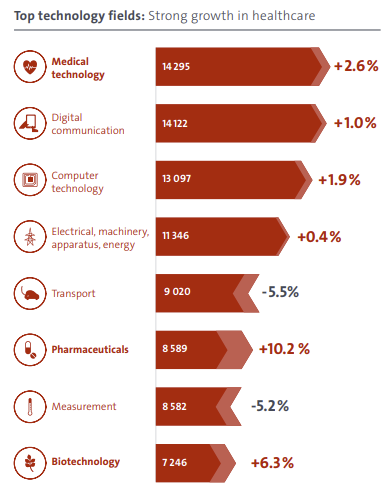
Given the ageing populations in developed countries around the world, it is perhaps unsurprising that healthcare technologies (including medical technology, pharmaceuticals and biotechnology) have increased.
Similarly, given the significant investment in computer and telecoms technologies by Chinese and South Korean firms, it is unsurprising that digital communication and computer technology were also up – a trend that is likely to continue in the years ahead, given the public’s insatiable desire for greater and faster data transfer for smartphones and tablet devices.
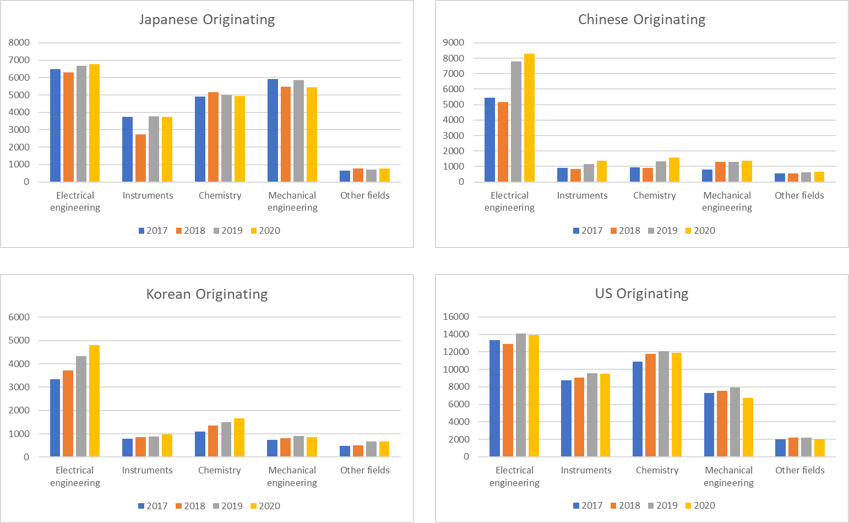
Further analysis of the EPO data reveals some interesting filing trends for applicants based in different countries; the tables below show the filing activity for applicants based in Japan, China, South Korea and the US.
As is evident from these graphs, filings from applicants based in Japan and the US were down overall, whilst for applicants based in South Korea and China, the filings were up in nearly all technical fields. Indeed, the number of cases filed by Chinese applicants in the general ‘electrical engineering’ field has now surpassed those filed in the same field by Japanese companies. At this rate of increase, it won’t be long before Chinese applicants are filing more EP applications than US-based applicants in this technical field.
The rate of filing by Chinese companies in this area clearly demonstrates China’s desire to dominate and control digital technologies (such as IoT and 5G) that will underpin the next technology revolution. Given the importance of these technologies to the future economic prosperity of all countries, it is perhaps unsurprising there is significant political unease in the West with Chinese dominance in this area.
It is clear for anyone watching the energy space, that hydrogen and electric vehicles (EVs) are two areas of significant investment and innovation in recent years, the two forming part of significant global efforts towards decarbonisation of the automotive sector.
In late 2020, German luxury car manufacturer, and part of the Volkswagen Group, Porsche, announced significant investments in electromobility. As a producer of high-performance, high-cost and long lasting vehicles, and under pressure internationally to reduce fossil fuel emissions and environmental performance, the company has announced its investment in the eFuels project, of which it will be one of the principal customers. The project, which is part of the Highly Innovative Fuels (HIF) Project is the product of a partnership between Porsche, Siemens Energy, AME, Enel and Chilean company Enap to produce e-fuels with the aid of wind power at the Haru Oni site in southern Chile. In this context, Porsche has invested €24m and the German Government has invested €9m.
The eFuel technology essentially uses electrolyser produced hydrogen, powered by wind energy, which is combined with atmospheric CO2 to produce methanol. This is in turn converted into a pure gasoline based on licensed Methanol-to-Gasoline (MTG) technology from Exxon Mobil. This green gasoline does not contain sulphur and is produced using sustainable energy sources. The eFuel concept represents an interesting collaborative approach from industry to supply Porsche and its customers with a greener fuel, through use of technology and expertise from a number of companies, while not necessitating engine modifications typically required where methanol is itself used as the automotive fuel. At the same time, Porsche, and its parent Volkswagen, have recently announced plans to open an EV battery cell factory in Tübingen in the southern state of Baden Württemberg, not far from HQ in Stuttgart. This move by Porsche essentially represents a two-pronged approach to minimise its emissions, on the one hand electrifying is future fleet and on the other hand using sustainably produced eFuels to reduce the overall emissions of its existing fleet. Its sister firm Bentley has similarly expressed a potential interest in eFuel technology.
While this approach will allow its existing fleet to continue, it is clear that for Porsche and many of its competitors the industry is moving to electrification, with German competitors such as Audi and BMW already selling pure electric vehicles, and with many more in the pipeline. As such, it is fitting that the majority of patent filings in battery technology over the last 10-15 years has related to EV power storage technology, generally focusing on Li-Ion battery technology, although in recent years redox-flow batteries have been increasingly investigated for stationary power storage. In many cases technical innovations on battery-based energy storage can apply equally to EVs as they do to stationary storage systems.
The wider move towards EVs is reflected in the sharp uptick in plug-in EV registrations over the last two years, which in the UK alone has doubled since 2019, from approximately 250,000 in 2019 to 500,000 in March 2021, with battery powered electric vehicles (BEVs) accounting for most of this growth, whilst plug-in hybrid vehicles have seen a smaller growth. This move is further reflected in the overall market share for plug-in EV of new car registrations in the UK, which was approximately 3% in 2019 and has reached almost 15% in early 2021.
In the wider context of battery development and innovation, the focus is very much on Japan and Korea, with large multinational electronics companies such as Samsung, Panasonic, LG Electronics, Sony and Hitachi in pole position. Toyota and Nissan are the most active automotive players. German company Bosch comes in fifth position of overall ranking of patents filed in the battery technology space. EPO reports indicate that this is heavily influenced by the energy policies in both countries. To strengthen the UK’s position in the field of electrochemical energy storage and battery technology, the Faraday Institution was established in 2017 as the UK’s premium research programme on innovations in battery technology, market analysis and early stage commercialisation. Under the auspices of the Faraday Institution, which is a collaboration of over 20 UK universities and 50 industry partners, new innovations are taking place in Li-ion, solid-state, sodium ion and Li-S batteries. The Faraday Institution recognises that EV technology is growing and the take up of electric vehicles in the UK alone is quickly increasing and is expected to reach 60%-70% in 10 years’ time.
According to recent reports, the UK has recently overtaken France as Europe’s second largest EV market after Germany. This trend looks set to continue, and clearly Porsche is not alone amongst the high-end luxury car manufacturers going electric. Lotus has recently announced a £2.5 billion investment in the UK to retrofit its UK factory for the switch to EV, with the firm planning to sell only EVs by 2028. This interest is clearly demonstrated in the patent portfolio of Lotus owner Geely, with many of the most recent patent filings from the Chinese automotive manufacturer relating to EVs and hybrid vehicle control systems, charging and energy storage system, power conversion and thermal management systems. A similar focus is seen across many of its competitors.
Overall, it is evident across the automotive sector that efforts are being made throughout the value chain towards decarbonisation and reduction of environmental impacts, and EVs will form a significant part of this approach.
In what has been a particularly difficult year for all students across the world, with much uncertainty and logistical changes, we are delighted to announce a record number of exam success for trainees in the Mathys & Squire team.
Our congratulations go to Alex Elder, Peter Humby and Oliver Parish, who have all passed their UK Finals exams, and are now qualified patent attorneys.
In addition to our new cohort of associates, we would like to congratulate technical assistants Thomas Bosworth, Jessica Eastwood, Rachael Evans, Liam Gannon, Jonathan Israel, Joe O’Gorman, Conor McGuinness, Lionel Newton, Clare Roskell, Helen Springbett, Leonard Wright and Max Ziemann for passing various modules as part of their UK exams on their path to qualifying as patent attorneys.
A number of our technical assistants have also passed their pre-European Qualifying Examinations (EQEs); well done to Jessica Eastwood, Rachael Evans, Liam Gannon, Sally Gao, Joe O’Gorman, Clare Roskell, Helen Springbett and Max Ziemann.
Technical assistants Szymon Pancewicz, Emma Powell, Lewis Scholes, Angela Stephen and William Wathey have all passed their Queen Mary Post Graduate Certificate exams; the next step for these individuals will be to take their UK Finals exams to become qualified patent attorneys.
Partner Alan MacDougall, who heads up Mathys & Squire’s HR function, commented: “We would like to extend a huge congratulations to all these individuals who have worked so hard in the last year to achieve these outstanding results. These candidates have all excelled at a time when there has been such uncertainty in both work and personal lives; and on top of this, they have dealt with the technical aspects of sitting the new online examination platform – either from home or the office. It is truly a testament to their hard work and commitment to their studies in progressing their careers as patent attorneys. Nurturing and developing talent is one of Mathys & Squire’s core values, so it is with great pride that we announce news such as this.”
In this article for The Patent Lawyer, Andrew White and Conor McGuinness develop key insights into patenting video games with exploration of unsuccessful and successful case examples.

Image credit – https://indivisiblegame.com/
US video game publisher Electronic Arts has recently announced its agreement to purchase UK-based video game publisher Codemasters for approximately $1.2 billion. This follows the recent acquisition of, for an undisclosed amount, Scottish video game developer Ruffian Games by another large US publisher, Rockstar Games. UK-based companies are therefore clearly playing a leading role in video game development and publication.
The UK consumer market is of similar scale; its gaming market is currently the sixth biggest globally with UK consumers spending an estimated £5.35 billion on game hardware and software.
As the UK video game industry looks set to continue its growth, developing a bespoke intellectual property (IP) strategy tailored to your company is of the utmost importance. Obtaining suitable IP rights will provide you with the opportunity to ‘fence off’ your innovations from competitors and potentially lock-in your customers. IP rights can also significantly push up the value of your company.
In this article, we look at the patentability of video games in Europe and the UK and address the common misconception that they are not patentable. In addition to patents, other IP rights such as trade marks, copyright and confidential information are also all highly relevant to video game developers and publishers, and should be considered as part of any overarching IP strategy.
Patenting video games in Europe
In essence, a modern video game is a piece of software describing a set of abstract game rules configured to be executed by hardware such as a PC or a games console. The European Patent Office (EPO) will grant patents to inventions that it considers provide a technical solution to technical problem, but does not recognise, among other things, programs for computers, playing games or mathematical methods, in and of themselves as inventions (Art. 52 (2),(3) EPC).
On the face of it, the ability to obtain patent protection for video/computer games therefore looks bleak.
However, the EPO will consider a computer program product an invention (and therefore, potentially patentable) if, when it is run on a computer, it produces a further technical effect which goes beyond the ‘normal’ physical interactions between program (software) and computer (hardware) (see Headnote of T 1173/97).
So when it comes to video games, although patents can’t be sought for the rules of a game in and of themselves, there may be patentable subject-matter in the way the rules of the game are implemented, provided there is some technical effect which goes beyond the ‘normal’ physical interactions between program and computer.
Whilst it is not possible to give a precise statement as to what the EPO will consider an invention when it comes to video games, a few examples of the types of video game patent applications that the EPO has found patentable and non-patentable are set out below.
What isn’t patentable?
In the case where an applicant appealed the refusal of their application claiming a method of operating an electronic video poker machine, the appeal was dismissed by the Board of Appeal because the Board found that the claimed method merely recited the rules of a new variant of poker and, therefore, related to the technical implementation of excluded matter in the form of game rules (see T 0336/07 – reasons 4.4).
Similarly, for a patent application directed towards a new variant of Tetris wherein the tetrominos rise in addition to ‘fall’, it was found that the claims related to games rules and there was nothing technical in how they were implemented (see T 1782/09 – reasons 4).
In addition to the game rules themselves that are not allowable, the exclusion appears to apply to in-game statistics and parameters too.
For example, an application claiming computer-implemented method for determining an indication of the relative skill of a first player and a second player based on the outcome of one or more games involving those players was found to be merely a mathematical method and not technical in nature. The applicant tried to argue the claimed method was technical because, in their opinion, it solved the technical problem of keeping players interested in the game by tracking their performance and then pitting them against a suitable opponent. However, the Board did not agree that keeping players interested was a technical problem (T 0042/10).
In another case, the applicant, Nintendo, was unable to patent a game where a kart is driven by two characters controlled by different players and the two characters could swap roles during the game which would affect the way the kart moves in response to a player input. Nintendo argued that swapping the roles of characters addresses the problem of making the game more surprising – and therefore exciting – for the players and that this was comparable to the generation of chance encounter events with less predictability as in T0012/08 (see below).
However, the Board was not convinced that this was a technical problem and asserted that virtual attributes of characters do not have a physical effect, they simply mean that different characters respond differently to user inputs when moving in the game space and, therefore, the claim related to game rules and was not patentable (T 0188/11).
What is patentable?
An application claiming a game wherein the probability of a character appearing on a game map was varied was, in contrast to the previous case, found to be patentable. The Board reasoned that the probability calculation was technical because it solved the problem of how to modify the game program such that it generated encounters in a less predictable manner (see T 0012/08).
In another patent application, it was found that a guide display device for use in a video game system was allowable subject-matter. In more detail, the guide display device highlighted a first character so that the player could identify them, as well as a pass guide mark, which allowed identification of a second character to whom a ball is to be passed. The pass guide mark continued to be displayed on the edge of the display area when the second character left the visible area. It was argued that the technical problem here related to conflicting technical requirements, namely: a portion of an image is desired to be displayed on a relatively large scale (e.g. zoom in); and, the display area of the screen may then be too small to show a complete zone of interest, which had to be considered in the inventive step discussion. The Board asserted that resolving the conflict by technical means implies a technical contribution (T 0928/03).
Lastly, in a case in which the applicant claimed a game wherein contact between a player character and background objects was calculated by determining whether an overlap existed between a set of points describing the player character and a block-shaped rendering area of the background objects, the Board found that this was a computationally effective and efficient approach to determining the contact between such objects and that this approach was not the inevitable result of programming the game rules per se. Rather, the claimed subject-matter was the direct technical consequence of the particular technical way selected data is used to determine a display state. (T 1225/10 – reasons 6.2.2).
Conclusion
From the above review, it is clear that video games, or at least aspects of these games, are patentable. Bearing in mind the size of the potential UK market, video game developers and publishers should be actively considering the patentability of their creations as part of a wider holistic IP review that also includes other IP rights such as trade marks, copyright and confidential information.
This article was originally published in The Patent Lawyer in April 2021.