This month we are proud to announce the launch of our brand-new podcast, Innovation Unlocked by Mathys & Squire, a new series designed to explore the dynamic intersection of intellectual property, entrepreneurship and innovation.
Hosted by Partner Andrew White, our podcast is designed to offer in-depth insights that resonates with innovators, founders, and professionals across the wider tech and creative communities.
Each episode will examine key topics and emerging trends that are shaping the IP landscape, helping listeners navigate the challenges and opportunities that come with protecting and leveraging one of their most valuable strategic assets.
We will be speaking with experts including renowned innovators, industry leaders, and legal professionals who can bring unique perspectives and real-world experiences to the conversation.
Our first episodes feature high-profile guests such as Lord Paul Drayson (CEO of Freevolt Technologies and former UK Minister of State for Science and Innovation), Joe Warren (founder of Powervault), and several of Mathys & Squire’s own IP specialists, including Partners Sean Leach, Posy Drywood, David Hobson and Nicholas Fox.



Watch the trailer for our new podcast here.
Subscribe to our YouTube channel through this link here.
Since the EU (Community) design system was first introduced in 2002, new technology – in particular new digital innovation – has given prominence to new types of “products” which the EU considers should benefit from design protection.
As part of ongoing efforts to modernise the EU design system, several key changes are being introduced. These changes aim to broaden and clarify the scope of design protection in the EU, while also making the system more accessible and user-friendly.
Non-physical “products”
In particular, as of 1 May 2025, the legal definition of the “products” that are eligible for design protection will now not only encompass products that are physical objects, but also products which materialise in a non-physical form such as graphic works or symbols, logos, and graphical user interfaces. The new regulations also explicitly recognise that animations, such as movements or transitions, of the features of a product can contribute to the appearance of designs and will therefore be explicitly eligible for design protection.
The “Locarno Classification”
Another change will be a simplification of how products are grouped together in design filings. Currently, to file products together as a multi-part design, products must fall within the same “Locarno classification.” For example, designs to a mobile device and a household appliance could not be grouped together in a multi-part application. This classification requirement is being removed, meaning that disparate products or features of the same overall system (with different Locarno classifications) can be filed together in a multi-part design filing. This new approach will reduce the complexity of design filings and will also reduce the up-front cost to applicants by consolidating what would previously have been several design applications into a single design filing.
Design rights holders will also be able to mark their products as having EU design protection by using a circled “D” symbol, similar to the symbols “®” and “©” that already exist for trade marks and copyright.
These changes are welcome, broadening the types of products that the EU design law protects to align with advancements in technology and technology commercialisation which have taken place over the last 20 years.
If you have any questions about obtaining design protection for your products, please contact our designs team.
We are delighted to announce that we have received the Committed Badge from EcoVadis, recognising our ongoing efforts toward sustainability and responsible business practices.
EcoVadis is a globally recognised sustainability assessment platform that evaluates companies on their environmental, social, and ethical performance.
The EcoVadis assessment includes 21 sustainability criteria with a comprehensive review of policies, actions, and results across four main categories: Environment, Labor & Human Rights, Ethics, and Sustainable Procurement.
As part of our commitment to society, our people and the environment, at the start of this year we completed a thorough assessment of our business sustainability practices through EcoVadis, and are now proud to share our results.
Why is it important to us?
Receiving the EcoVadis Committed Medal is a positive step in our ongoing sustainability journey. It reflects the foundational work we’ve done to integrate environmental, social, and governance (ESG) principles into our operations. This recognition provides an external validation of our commitment to responsible business practices, and it encourages us to continue building on this progress.
Click here to read more about our Corporate Social Responsibility initiatives.
Mathys & Squire partners with the Swiss Startup Association as a Legal Partner to support the IP work of startups and small businesses within their network. Partner Andrea McShane, Managing Associate Aymeric Vienne and Associate Danielle Champagne form our contact team.
The Swiss Startup Association (SSA) is a company dedicated to supporting small businesses with a plethora of networks and resources. With over 1600 startup members, they help encourage the sustainability of the latest innovation and creativity in Switzerland.
Regarding the new partnership, Partner Andrea McShane writes: ‘As an ETH graduate the Swiss start up landscape is close to my heart – and it is such a pleasure to be involved, and to be able to give back in this way. Hopp Schwiiz!’
Through the Swiss Startup Association, Mathys & Squire are offering three different start up packages tailored for the different needs of businesses. As well as this, for SSA members, we are offering a free initial patent filing strategy consultation.
Andrea will also be attending the 2025 Founders Day in Zurich on the 15th of April. Taking place at the Google Campus Europaallee, the event is an opportunity for startups to hear from founders and investors who will share their own experiences, knowledge and expertise to the attending audience.
Click the link here to read more about the partnership.
Mathys & Squire is delighted to have been recognised in JUVE Patent’s UK rankings 2025 for the sixth consecutive year in the fields of ‘Pharma and biotechnology’, ‘Medical technology’, ‘Chemistry’, ‘Digital communication and computer technology’ and ‘Electronics’.
As well as a practice-wide recommendation for the firm, four of our Partners have been recognised as Recommended Individuals: Philippa Griffin, Hazel Ford and James Wilding for ‘Pharma and Biotechnology‘, and Chris Hamer for ‘Chemistry‘.
The JUVE Patent rankings are a result of thorough research conducted by an independent team of journalists, who send out questionnaires and conduct interviews with lawyers, clients, legal academics and judges. In the 2025 edition, UK patent practices, solicitors and barristers who, according to the in-depth research, have a leading reputation in the UK patent law market are celebrated.
To see the JUVE Patent UK 2025 rankings in full, please click here.
On 12th March, Mathys & Squire sponsored the 2025 NLIL conference for the second year running, hosted at LSE. Partners James Pitchford and Anna Gregson , Technical Assistant Louis Brosnan and Trainee Trade Mark Attorney Tanya Rahman all spoke at the event.
The Non-Law Into Law (NLIL) Conference was first held in 2024 and returned last week after their debut success last year. The event was tailored to students from a diverse range of academic disciplines studying a total of 117 different degree subjects, and successfully highlighted the various pathways available for those interested in pursuing a legal career, even though they may not be currently studying law.
Hosted at LSE, societies from various universities including Imperial College, Warwick, UCL, Durham and Queen Mary were in attendance, with over 300 tickets sold to students who actively listened and engaged with a series of panel discussions, presentations and interactive workshops.
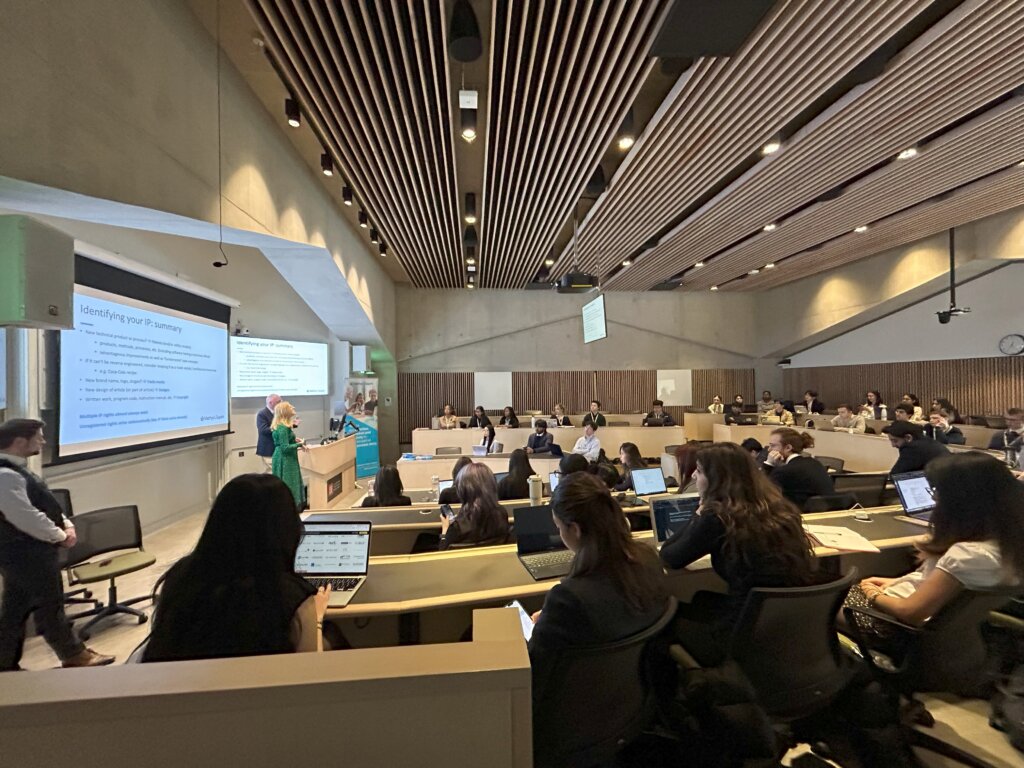
Photo from the 2025 NLIL Conference
From our Mathys & Squire team, we led an IP Workshop, which presented an introduction to Intellectual Property to the attending students, covering the various areas of patents, trade marks, registered designs and copyright, as well as a Careers in IP seminar, examining the different professional paths within the field.
It was a pleasure to attend the event and our team was extremely impressed with the engagement and enthusiasm demonstrated by the attending students.
Find more about the NLIL conference on their website here.
Mathys & Squire LLP is delighted to have achieved a significant victory for our client D.W. Windsor Ltd in its patent infringement claim against Urbis Schréder Ltd in the High Court. DW Windsor are a leading British designer and manufacturer of lighting solutions, found in areas such as Tower Bridge, the London Eye, St Paul’s Vista, and the Square Mile in the City of London.
Mathys & Squire LLP is delighted to have achieved a significant victory for our client DW Windsor Ltd in its patent infringement claim against Urbis Schréder Ltd in the High Court. DW Windsor are a leading British designer and manufacturer of lighting solutions, found in areas such as Tower Bridge, the London Eye, St Paul’s Vista, and the Square Mile in the City of London.
The dispute concerned two patents drafted and prosecuted by Mathys & Squire LLP directed to DW Windsor’s Garda AntiClimb® range, a surface-mounted linear lighting system for illuminating walled pathways.
Nearly two years ago, DW Windsor commenced patent infringement proceedings in the Intellectual Property Enterprise Court with the aim of enforcing its patents and protecting its technology. Schréder denied infringement and counterclaimed for revocation of the patents. By the time of the trial, the issues before the Court were limited to validity.
The trial took place in the Intellectual Property Enterprise Court on 17 and 18 December 2024, and in a judgment handed down on 14 March 2025, Her Honour Judge Melissa Clarke held that key claims of DW Windsor’s patents were valid and therefore infringed. The defendant was therefore unsuccessful in its attempt to seek to revoke D.W. Windsor’s patents.
Andrew White, Partner at Mathys & Squire LLP commented: “We are delighted to secure the resounding victory for our client DW Windsor. DW Windsor is a highly innovative British business with IP at its core.
While litigation is rarely a first choice for many, sometimes it is necessary to stand up for your IP rights and in this case D.W. Windsor were willing to protect their investment by taking enforcement action through the courts.
This judgement confirms DW Windsor’s position as innovators in the field of lighting solutions and that they are not afraid to stand up for their IP rights. It was a pleasure to work with the client Alan Grant, Lucy Marlow of Fox Williams, and Adrian de Froment of Serle Court on this matter.”
DW Windsor added:“We’re delighted with the result of the Judgment and the knowledge that our patents will continue to provide protection to the business.
Innovation has been at the heart of DW Windsor since the business was founded, and our Garda Anti Climb products exemplify our commitment to creating new lighting solutions that improve the status quo by leveraging our considerable experience, embracing technology and challenging convention through innovative design and engineering excellence.
We invest heavily in research and development and encourage free-thinking in our technical team to push the boundaries in lighting product design and as a result invest in intellectual property and protect and enforce those rights should they be infringed.
I’d like to thank and acknowledge the tireless professionalism of our legal team, including Lucy Marlow of Fox Williams, Adrian de Froment of Serle Court and Andrew White of Mathys & Squire who helped secure this victory.”
The full judgement can be read here.
This press release was featured in The Solicitor’s Journal.
Mathys & Squire LLP are a full-service IP firm with unrivalled expertise in patents, trade marks, design protection and litigation.
Commentary by Partner Edd Cavanna has been featured in UKTN and The Patent Lawyer Magazine discussing how the UK patent system might be restricting innovation in the quantum computing sector and how Europe has become a desirable place to patent new technology.
Read the extended press release below.
The UK Intellectual Property Office (UK IPO) may be discouraging innovation in Quantum Computing by making it harder to patent technology in this sector, says intellectual property law firm Mathys & Squire. That risks driving developers of Quantum Computing to patent their inventions in Europe or further afield and risks making the UK a less attractive venue for Quantum Computing R&D.
The UK IPO currently treats quantum computational algorithms the same way as other (classical) software. Software can only be patented in the UK if it can be demonstrated to have a technical effect going beyond mere routine software automation. This usually means an effect on real world processes outside of the computer – for example software that manages a process in a chemical factory, or provides improved image de-noising.
The existing framework for assessing patentability of software has been developed over many years, but can mean that emerging technologies (Artificial Intelligence, Quantum Computing) struggle under old guidelines.
Dr Edd Cavanna, Partner at Mathys & Squire, says: “The UK patent system and its treatment of strategically important technologies like Quantum Computing and AI is overdue a review. The risk is that we will drive cutting edge Quantum Computing designers elsewhere unless we update our approach.”
“Changing the assessment framework may be a challenge but it’s an important step if the UK is going to improve its attractiveness as a location for the Quantum Computing sector.”
The framework for patenting computer software has been developing since the 1970s. Then, much of the technical effect* (required for an invention to avoid software exclusions from patentability) could more clearly be broken down along hardware/software lines. Quantum Computing software allows processing of data in a radically different way to conventional software but is still currently judged on the same basis in the UK.
Europe a far better prospect for patenting quantum computing tech
By contrast to the UK, Europe’s approach to patenting quantum computing software is a lot more permissive. The UK IPO is not required to undertake a formal search and examination of a patent application until the Examiner is convinced that the invention displays a technical effect. By contrast, the European Patent Office (EPO) will consider all aspects of patentability on filing. This allows a discussion between the inventor and the Examiner from the get-go, allowing the inventor to emphasise the technical effect of the invention in the broader context of patentability in general.
Quantum software may seem like conventional software in its technical effect, as it is often based on mathematics or makes use of conventional software.** Therefore, the UK IPO will often raise an objection that the patent application is non-technical. This makes it difficult to proceed in the UK and means that the EPO is a more predictable and engaging forum than the UK IPO for patenting Quantum Computing software.
Quantum Computing leverages quantum mechanics to approach information processing in a fundamentally different way. At its core, Quantum Computation leverages the ability of a quantum object to exist not in a single state, but in a superposition of two (or more) states. By analogy to classical computation, where a bit must be in a 0 or 1 state, a quantum bit, or qubit, can be in any superposition of the 0 and 1 states. By combining multiple qubits in carefully controlled superpositions, the information processing takes on a completely different form. Many developers hope Quantum Computers could one day be used to solve problems that are currently too difficult for computers today by leveraging this new way of approaching information. Areas looking to benefit from Quantum Computing developments include:
- Materials modelling and pharmaceutical discovery, who are hoping to use increased processing power to discover new materials, drugs and vaccines faster.
- National security, as quantum computing can be used in R&D of materials for military vehicles and to help decipher encrypted messages.
- Optimisation problems, finding ideal parameters in complex and rapidly changing systems, such as supply chains.
Outdated IPO rules may not be fit for purpose
Dr Edd Cavanna points out that the UK IPO tends to regard Quantum Software as broadly equivalent to classical software. This means that the complete rethink of how information is represented and processed in Quantum Computing may not be given due weight under the current system.
Dr Edd Cavanna says: “The longstanding framework for assessing software applications in the UK appears to be outdated in view of today’s technological innovations. A review of this framework to account for the unique properties of Quantum Computation would be very welcome, rather than applying blanket rules, developed under the classical computing framework, to this emerging field.
Dr Cavanna notes “Regrettably, a recent update to the framework under which the UK IPO assesses software, including quantum computer algorithms, has not shifted the dial as much as was hoped. Both patent examiners and inventors would benefit from a detailed review of rules in view of the contemporary technological landscape”.
*Technical effect means broadly that inventions in the software space need to show an impact beyond the computer, leading to a real-world improvement.
** Quantum computing often involves classically executed method steps, and is usually reasonably mathematically complex.
Mathys & Squire Associate Emma Pallister has been featured in The Trademark Lawyer Magazine with her article, ‘The rise of influencer marketing and IP implications’.
An recent article by Associate Emma Pallister has been published in The Trademark Lawyer Magazine titled ‘The rise of influencer marketing and IP implications’. In this piece, Emma discusses the increased consumer trust of influencers, IP risks for brands, influencer liability and the prevalence of counterfeit goods online.
To read the article in full, click the link here.
Commentary by Managing Associate Adam Gilbertson has been featured in The Global Legal Post, Solicitor’s Journal and The Trademark Lawyer as he responds to the latest UK Government AI Consultation regarding the implications of marking AI generated content.
Read the extended press release below.
Will the UK Government mandate that AI users mark their content as AI generated?
The UK Government should seriously consider mandating AI users to mark their content as AI generated says leading property law firm Mathys & Squire in response to the UK’s consultation on AI consultation that closes on February 25.
In December 2024 the UK Government launched a consultation on how copyright law should be changed to take into account the rise in Gen-AI (Copyright and Artificial Intelligence). The document asks for readers’ advice on whether AI material should be flagged as being created by AI – and whether the Government should be responsible for regulating that.
Currently, there is no obligation for material generated using artificial intelligence to be marked as such.
Adam Gilbertson, Managing Associate at Mathys & Squire, says that “As content generated using Gen-AI becomes increasingly indistinguishable from genuine manmade material, in many cases it’s in the public interest to know what material has been generated by AI so that they can make a properly informed opinion about that material.”
That applies to a whole range of content from Gen-AI created reports, articles and newspaper stories through to Gen-AI images, and not just for copyright purposes but for wider authenticity and bias concerns.
UK Government must balance responsibly to protect copyright holders with need to drive AI R&D in the UK
In the Copyright and Artificial Intelligence consultation, the Government indicates that it favours an ‘opt-out’ model of making copyrighted material unavailable for AI training, similar to the EU’s current text and data mining (TDM) exception. This would mean copyrighted material can be used for training AI for commercial purposes unless the copyright owner makes it clear (in some way) that they have ‘reserved their rights’ to such material.
Adam Gilbertson says that this is a sensible middle ground that should help ensure that content creators can seek fair remuneration for use of their copyright protected works whilst providing a safe harbour for AI developers, helping to make the UK a welcoming environment for AI R&D without too much red-tape.
Government must standardise how copyright holders opt-out from AI models training on their data
Adam Gilbertson also recommends that the Government should standardise the way in which copyright holders opt-out of such an exception and reserve their rights to help avoid potential disputes over what material is and is not available for commercial use.
Says Adam Gilbertson: “There is a big question mark over how to implement such an opt out in practice to avoid confusion over what material is and is not freely available for use. Lessons should be learnt from the uncertainty and disputes that have arisen in the EU over what counts as a valid opt-out of the EU’s TDM exception due to a lack of standardisation. If the UK goes down this route, some form of standardisation would help provide greater legal certainty and make it easier for AI companies to operate in the UK.”