Partners Hazel Ford and Alexander Robinson have been featured in the Life Sciences IP Review (LSIPR) providing insights on the latest developments impacting the European Patent Office Boards of Appeal, following their discussion held at LSPN Spring North America 2025.
In their talk, they analyse the evolving legal landscape in the life sciences sector in light of recent decisions prompted by the Unified Patent Court, offering a valuable perspective on how these changes may affect patent strategies across Europe.
To watch the full video click here.
How can you keep track of innovations made by your competitors? Do you even know who all your competitors are? Monitoring patenting activity can help, but there are limitations. Surprises can still happen, sometimes from unexpected quarters.
June 2025. Another week, another news article with a colourful photograph of a rocket exploding. But as news feeds were focussed on the latest ‘Starship’ blow-up as SpaceX doubled down on its fail fast, learn fast methodology, the attention of much of the space industry was elsewhere. To northern Japan, where a day earlier a prototype rocket had risen some 300m into the air and, a minute later, redeployed its landing gear and landed flawlessly a short distance away. The technology was undoubtedly impressive, but the most newsworthy aspect was the identity of the company behind it.
Since the first commercial launch system was offered by Arianespace in the 1980s, arguably the greatest advances have come from SpaceX, who first demonstrated the result of a decade of development by launching a reusable rocket in 2015. Since then, SpaceX has become by far the dominant player with currently over 100 orbital launches a year. It has also inspired numerous start-ups. But the new rocket was not from any of those. The unexpected new entrant in the reusable rocket space was the venerable Japanese car manufacturer: Honda¹.
What was ostensibly a car company doing launching a reusable rocket? And could anyone have seen this coming?
The monitoring of patents – and in particular the filing of new patent applications – is often presented as a key tool for competitor intelligence. What areas are your competitors working on? What new innovations have there been in your field? Have there been any new entrants? Patents are by design a good source of technical information; to secure a patent monopoly requires full disclosure of the workings of the invention, which nowadays is readily available on free public databases.
However, patent monitoring is an imperfect tool. The language can be obscure, a dense mix of technical and legalese, sometimes deliberately so. Subject classifications are not always appropriate. The ultimate corporate owners can be difficult to determine. And patent applications typically only publish 18 months after the initial filing, so any such monitoring is inevitably somewhat behind the curve.
Another reason to be wary is that the incentives to file patent applications differ; what works for start-ups is not always appropriate for more established companies. The former tend to file early in the innovation process to indicate commercial potential, secure investment, and to protect their key innovation ahead of any public demonstration. We can see this with the large number of reusable rocket start-ups with a handful of patent filings, perhaps some successful ground-based test firings, but as yet no successful launches. Large companies (or those with more secure funding) tend to have a broader technological base and no need to engage in such market signalling.
Leaving aside ideological reasoning (Elon Musk once famously quipped that patents are “for the weak” and claimed SpaceX was a patent-free company; a position since evidently revised), for some companies, the very requirement to disclose in full details of the invention is seen as a drawback, allowing competitors an unwanted innovation leg-up. Instead, development is undertaken largely in secret, with intellectual property being protected through corporate culture – or in case that fails, formally buttressed via strict non-disclosure employment contracts and the potential for litigation.
Honda seems to be adopting this secrecy approach, at least initially. Since first declaring an interest in developing space technologies in 2019, they have kept a low profile. Footage of an earlier rocket test firing was only shown in grainy black-and-white, possibly to avoid disclosing details of the propellant.
They evidently take patents seriously, however. Established in the 1940s, Honda is one of the largest automobile manufacturers in the world, with vast experience in combustion technology, fluid handling, etc., and a large R&D department with a reported willingness to allow young engineers opportunities to work on projects of their own. For the past two decades, Honda has filed over 1,000 patent applications a year.
Honda also has prior form in diversifying into other technology areas, whether done primarily as a proof-of-concept and public-relations exercise (as with the ASIMO humanoid robot programme, since discontinued) or commercially. Honda has, for example, a successful side line in business jets and a small portfolio of aviation-related patents.
That said, Honda seems unlikely to be aiming to compete with SpaceX as a commercial launch provider. Rather, this may be a case of vertical integration, a company looking to support its core business by moving into adjacent technologies. Honda may in time provide its own satellite links for ‘connected vehicles’, avoiding over-reliance on the present dominant supplier (Starlink again).
Whatever the reason, Honda could well become a major force in the intellectual property of space, following similar industrial giants such as Toyota, Mitsubishi, and Hyundai, all of which have been building space-related patent portfolios.
So if your company is warily eyeing existing competitors and wondering where the next threat might come from, how can you anticipate competition arising from established companies crossing over from other sectors?
- Be aware that innovation and competition not only come from smaller companies and startups. Not all large companies are dinosaurs.
- Appreciate that patent monitoring is important but also imperfect and so must be part of a wider analysis.
- Take public pronouncements seriously. Whereas start-ups seek to make headlines, larger
companies may be indicating a deliberate strategy. - Identify companies with the means, motive, and opportunity to vertically integrate or diversify.
- Note when unexpected new entrants move into your technology area and consider whether there are similar companies which might do likewise.
You may also wish to consult with your patent attorney. Despite the drawbacks with patent monitoring, there are sometimes faint signals which a patent attorney might identify. A couple of years ago, a Honda patent application was published with the intriguing title “Landing gear for flight vehicle”. There was no mention in the patent specification of space or the launching of rockets. But a remarkably similar landing gear was seen deployed a few weeks ago in northern Japan.
¹ https://global.honda/en/topics/2025/c_2025-06-17ceng.html
The highly anticipated trial between Getty Images and Stability AI concluded on June 30, 2025. The case has gained national attention, as it represents a pivotal moment for the future of AI and copyright law in the UK.
On 16 January 2023, Getty Images brought proceedings against Stability AI, alleging that the AI company infringed Getty’s copyright by using millions of Getty’s images to train its generative AI model, Stable Diffusion, and that the outputs produced by the model reproduce substantial parts of these works.
The trial, which began on 9 June 2025, has attracted attention from both the technology and legal sectors, as it raises fundamental questions about how existing intellectual property laws should apply in view of modern generative AI systems.
In this article, Technical Assistant Egheosa Ogbomo and Partner Andrew White analyse the proceedings to date and the potential implications of any future developments.
Who are Stability AI and what is Stable Diffusion?
Stability AI is a UK-based artificial intelligence company which develops the family of Stable Diffusion AI models, open-source image generation tools capable of creating or altering images based on text or image prompts. Stability AI trained the original Stable Diffusion model on a subset of a dataset containing billions of images scraped from the internet.
Claims made by Getty
Copyright infringement claims
Getty alleges that Stability AI committed primary copyright infringement by reproducing substantial parts of millions of its images during Stable Diffusion’s training. This involved downloading, storing and augmenting them. They further claim infringement by making Stable Diffusion publicly available in the UK via Dream Studio and other open-source platforms, thus communicating significant parts of Getty’s works.
Getty alleges secondary infringement by authorising users to reproduce or communicate its works when outputs closely resemble Getty images. Secondary infringement due to the distribution of the trained model (an alleged infringing article) in the UK is another claim.
Trade mark infringement and passing off
In addition, Getty claims infringement of its trade marks, asserting that Stability AI used Getty’s marks without consent when generated outputs include Getty watermarks, causing confusion and exploitation of its reputation. They also allege passing off, arguing that generated images containing Getty logos misrepresent them as Getty-owned or licensed, implying endorsement.
Defences brought by Stability AI
Copyright infringement
Stability AI argues that any copying during data sourcing and training occurred entirely outside the UK, as they stored the datasets abroad. According to them, no infringing work was done in the UK. They claim output-stage infringements are the fault of users, since users control the input prompts and, in the case of image-prompts, the degree of input transformation.
Furthermore, they argue that any reproduced portions of Getty’s works are so minimal that they do not constitute a substantial part of copyrighted works and maintain that Stable Diffusion is not an infringing article. They may also rely on the pastiche defence, asserting that the extent of use of Getty’s work was necessary for pastiche, stating that this use does not affect the market for any originals.
Trade mark infringement and passing off
Stability AI claims that outputs containing Getty trade marks were only created through deliberate efforts by Getty’s legal team and do not reflect its normal commercial use. Furthermore, Stability AI denies any likelihood of confusion or unfair advantage. For passing off, it argues any misrepresentation arises from user actions and that outputs are not sufficiently similar to Getty’s works to mislead the public.
Key case developments so far
Since the trial began, Getty Images have dropped their claims for primary copyright infringement, citing a lack of evidence and knowledgeable witnesses to support the allegations. They also dropped their claims over the model’s training and development, maintaining that infringing acts occurred but that there were no witnesses from Stability AI who could provide clear and comprehensive evidence about the entire training process.
For the claims concerning AI-generated outputs, Getty stated that Stability AI has implemented measures preventing the reproduction of infringing outputs. Getty has been unable to establish that any outputs produced by the models reflect a substantial part of its protected images.
This illustrates the difficulty in proving exactly where the training of an ML model takes place for the purposes of determining infringement, as well as demonstrating that AI-generated images reproduce a ‘substantial part’ of protected original works. While this has narrowed the scope of the dispute, Getty’s claims of secondary infringement and trade mark misuse remain in contention.
What are the implications for IP law?
There remains significant uncertainty over the balance of power between AI developers and content creators on copyright licensing. A win for Stability AI in these proceedings could reduce the incentive for AI developers to seek licences in the UK and may lead some to continue developing models without securing permissions, or to do so outside of the UK. This has prompted questions about whether legislative reforms are needed to address potential gaps in protection. However, extending UK copyright law to cover acts abroad could create conflicts with foreign regimes such as US fair use, risking the UK’s attractiveness for AI research and model development.
There has already been a significant increase in the number of AI-related patent applications globally, with the European Patent Office observing a 45-fold increase in the annual number of AI-related European patent filings since 2015. How UK courts interpret copyright law for AI training and outputs could influence the approach to patent applications for AI-related inventions in the UK. Uncertainty over data use rights may consequently affect the development, disclosure and protection strategies for new AI technologies. Companies already face rising costs of data collection, particularly as new technologies such as Cloudflare’s tool will allow website owners to charge fees for access by web-scraping tools.
A final judgement on the remaining claims is likely to be handed down in the next few months. This will set an eagerly awaited precedent for how UK infringement laws should be interpreted in the age of AI, and large-scale text and data mining.
If you have any questions as to how the outcome of these proceedings may impact your IP strategy, please reach out to your usual contact at Mathys & Squire, or get in touch through a general enquiry and we would be happy to help.
Mathys & Squire Partner Michael Stott was recently featured in ‘EPO appeal board establishes ‘on-sale bar’ with big implications for patent owners’ by IAM Magazine. He provided commentary on the ruling on G1/23, issued by the EPO’s Enlarged Board of Appeal on the 2nd of July.
The ruling concerns the interpretation of prior art, determining in particular when a complex product put on the market should be considered part of the state of art and the extent of “reproducibility” which entails prior art status. Previously following a narrow definition of the “reproducibility requirement” established in the EBA’s G1/92 ruling, the EBA lays down in G1/23 that “a product put on the market before the date of filing of a European patent cannot be excluded from the state of the art […] for the sole reason that its composition or internal structure could not be analysed or reproduced by the skilled person.”
The article in IAM highlights how this new decision will have significant ramifications for the patentability of products across a wide range of technological fields, affecting how innovators approach their IP strategy, including when to file patent applications and the use of trade secrets.
To read the full article click here.
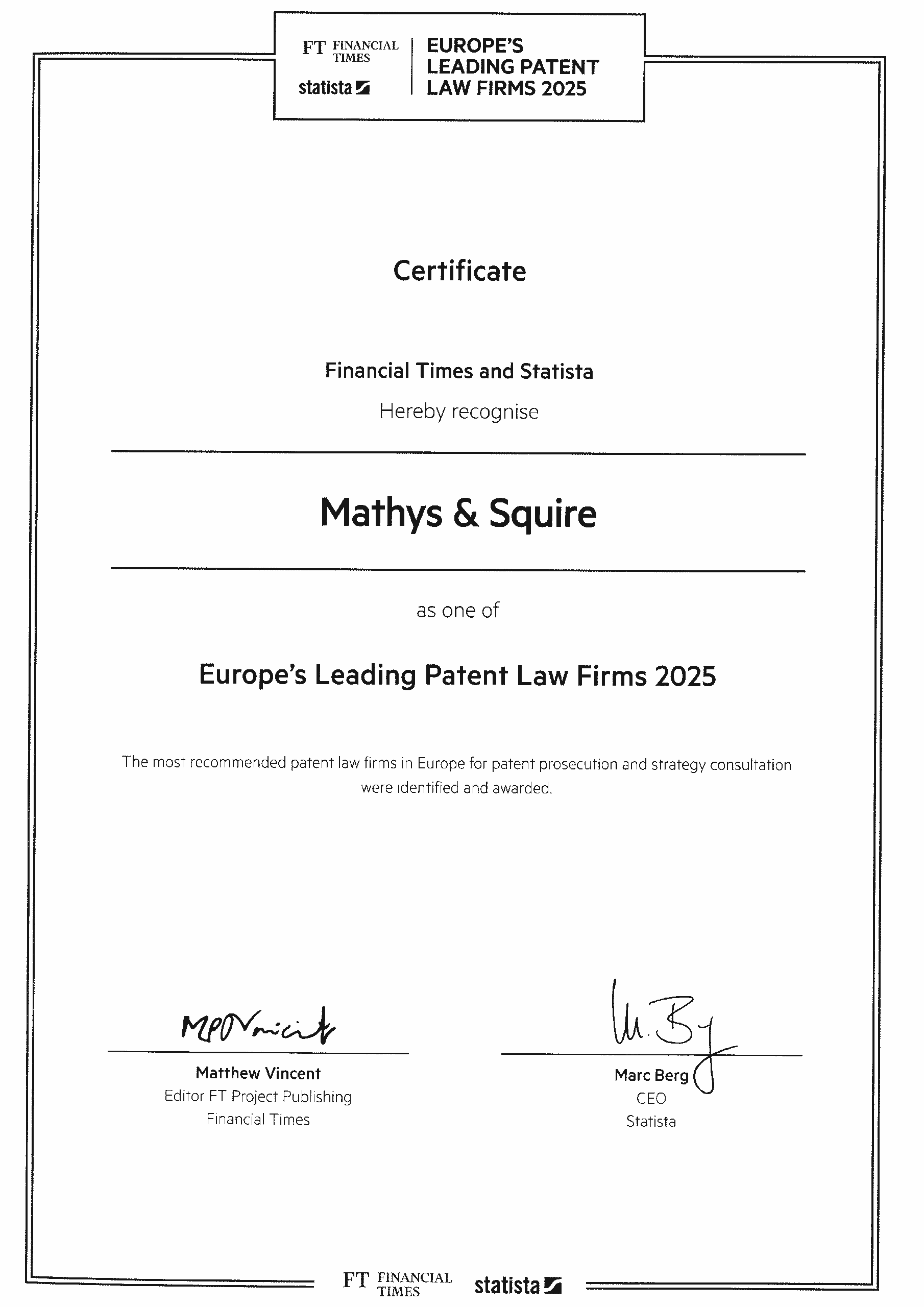
We are delighted to be ranked as a leading European patent law firm by the Financial Times (FT) in their 2025 report.
The Financial Times Europe’s Leading Patent Law Firms list identifies the most recommended firms in Europe for services related to patent prosecution and strategic advice, and is compiled by the FT’s research partner Statista.
As well as featuring as a leading patent firm, we have also been recognised in five specialist areas of industrial expertise this year: ‘Biotechnology, Food & Healthcare‘, ‘Chemistry & Pharmacy‘, ‘Electrical Engineering & Physics’, ‘IT & Software‘, and ‘Mechanical Engineering.’
We are greatly appreciative of all of our clients and contacts who have taken the time to recommended our firm as part of the FT’s research.
To access the full report and rankings tables, please visit the FT website here.
The UK Intellectual Property Office (UKIPO) has published a new guidance following the pivotal ruling in SkyKick UK Ltd and another v Sky Ltd and others (SkyKick). The updated Practice Amendment Notice 1/25 refines the examination practices at the IPO and outlines the implications of the judgement for new applicants when filing specifications of goods and services. Such changes are to come into effect immediately.
Background
Section 3(6) of the UK Trade Mark Act 1994 prohibits registration of a trade mark “if or to the extent that the application is made in bad faith.” What constitutes ‘bad faith’ is not legislatively defined, however, has been interpreted by the courts. Most notable is the recent Supreme Court Judgement in SkyKick following a long-running dispute between the parties. While the court confirmed a finding of infringement of Sky’s trade marks by SkyKick, it was found that Sky’s registrations contained excessively broad specifications across a range of goods and services for which there were no genuine intention to use the mark, and therefore, partially invalid on bad faith grounds.
Under the new guidance, examiners will now actively consider whether a specification is “so manifestly and self-evidently broad that a bad faith objection should be raised.” It follows that that certain applications claiming all 45 classes or all goods/services in those classes for example, will now automatically trigger an objection.
Looking Ahead
As a general rule, applicants should ensure that their specifications include goods and services which represent “fair and reasonable claims in the context of their business.” Going forward, applicants should exercise caution when filing a vast number of goods and services across a broad range of classes, or when using broad terms such as clothing, software, entertainment etc. That said, a pragmatic balance needs to be struck to not file too narrowly to restrict opportunities for business expansion.
Should an objection be raised by an examiner, applicants must be prepared to explain the commercial rationale behind the goods/services concerned. Paragraph 15 of the PAN 1/25 provides a 2-month period for a response. If the examiner refuses to waive the objection, applicants will still have the opportunity to be heard and to appeal. If the applicant genuinely is going to offer all goods/services applied for and can provide a justifiable commercial rationale and reasoning, we would expect the objection to be overcome.
Finally, opponents and cancellation applicants are also encouraged to be mindful of the changes above. as relying on broad specifications may lead to counterclaims from the other side on bad faith grounds. This has already been happening since the SkyKick judgement though in practice, but it is worth a reminder that this is possible as part of the proceedings before the UKIPO.
Mathys Comment
This is not an unexpected development by the UKIPO, but it will cause challenges for applicants who are used to filing with broad specifications (both in terms of classes and goods within the same class). Whilst the UKIPO does have an effective online tool to assist with drafting specifications, given the drafting of such defines your protection (and scope to challenge moving forwards) we would certainly recommend seeking advice from one of the Mathys trade mark team to ensure a) your specification covers you now (and moving forwards) and b) will ideally not trigger an objection.
Between August and October 2023, the UK government launched its Second Transformation Consultation to support the UKIPO in delivering improved digital services. One key proposal is to change, or potentially abolish, the use of series trade marks.
Series trade marks are a unique feature of the UK system, allowing applicants to register up to six similar marks (e.g. logos in different colours, differences in capitalisation, minor variations of spelling) in a single application at a reduced cost. This option is not available in other systems such as the EUIPO or the Madrid Protocol. Applicant’s were able to apply for up to six marks in a series, in accordance with Section 41(2)(a) of the Trade Marks Act 1994:
”A series of trade marks means a number of trade marks which resemble each other as to their material particulars and differ only as to matters of a non-distinctive character not substantially affecting the identity of the trade mark.”
Series marks are particularly useful when a logo appears in multiple colour variations or has several common adaptations, as they extend protection to all versions. They are also advantageous when a logo includes variations in visual elements, such as differences in colours, icons or stylised text, depending on the context. Overall, series marks offer broad legal protection while allowing for flexibility in how the logo is used across different scenarios. Despite variations in the marks, a series trade mark ensures consistency in the brand identity, protecting the core mark while enabling adaptation for numerous applications.
However, on 10 April 2025, the UKIPO published the consultation report and found that many applicants find series marks confusing. Specifically, 65% of applications are filed without professional representation, and in 2022, 39% were objected to for not meeting the legal criteria for registering a series of trade marks. This can lead to additional costs for applicants who need to file new applications. However, applicants would need to at least double filing costs without the series mark being available if they wanted to file more than one variant of their mark, so it is difficult to see how not having the series mark would lead to a cost saving on the whole. Furthermore, the UKIPO is of the opinion that series marks provide limited additional legal protection, reducing their overall value for money.
While this is arguable as we have found series marks to be a very beneficial tool for brand owners when used correctly, we do acknowledge that the UKIPO’s approach to assessing the validity of a series trade mark application is strict and any variations as to the distinctiveness of the mark to the point where the overall identity and impression of the trade mark has changed, even due to variations of colour, the application can be objected against or refused.
Professional representation is key to making the most out of the series system in the UK and it is somewhat disappointing that the UKIPO have decided to phase these marks out. While existing series marks will remain valid, the UKIPO expects to phase out the option for new applications once its new digital trade mark service launches. A specific date for this change has not yet been confirmed. If you have any marks which could constitute a series it would be beneficial to file them sooner rather than later.
In addition to developments at the UKIPO, as part of its digital transformation, the UKIPO will soon make trade mark and design documents, such as examination reports, available online for the first time through the new One IPO Search tool, bringing patents, trade marks, and designs into one unified platform.
Government response to the Second Transformation Consultation report below on series trade marks applications and more here.
On Wednesday the 25th of June 2025, Mathys & Squire hosted Dr Victoria McCloud, former Judge in the High Court and advocate for LGBTQIA+ rights, in our London office in honour of Pride Month.

From a young age, Victoria discovered a fascination with computers, as well as an acute awareness of human behaviour and interactions – experiencing life through the eyes of a girl as a registered boy at birth. These interests motivated her to pursue a degree in Experimental Psychology and a doctorate in the computational aspects of human vision.
After graduating, she practiced as a barrister, when she came out as a transgender woman, and then went on to be the youngest and first (and only) transgender Master in the UK High Court of Justice.
In 2024, she resigned as a Judge, feeling that there was no longer a place for her as a trans person in the UK court. Now, Victoria McCloud is a freelance public speaker, author and media commentator, raising awareness for issues affecting the LGBTQIA+ community and speaking directly from her experience as a trans woman.
Last year, she featured on the Dow Jones News “Pride of Finance”, whilst this year she reached first place in the Independent Newspaper Pride List and featured in Attitude Magazine’s 101 LGBTQ+ trailblazers 2025.
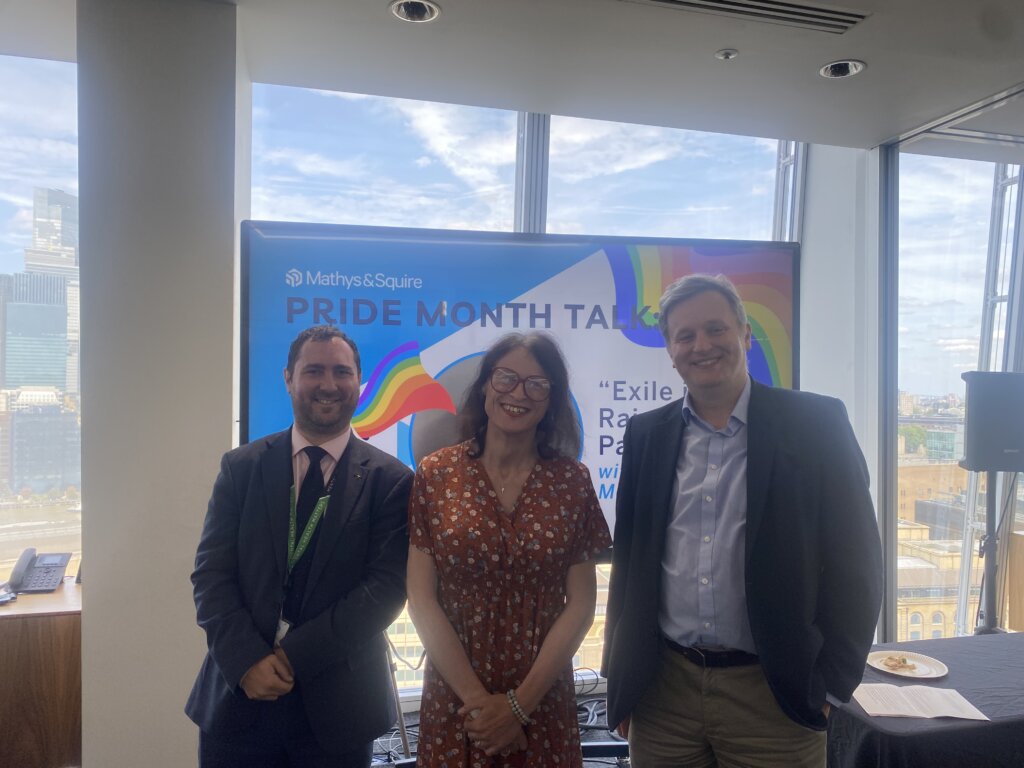
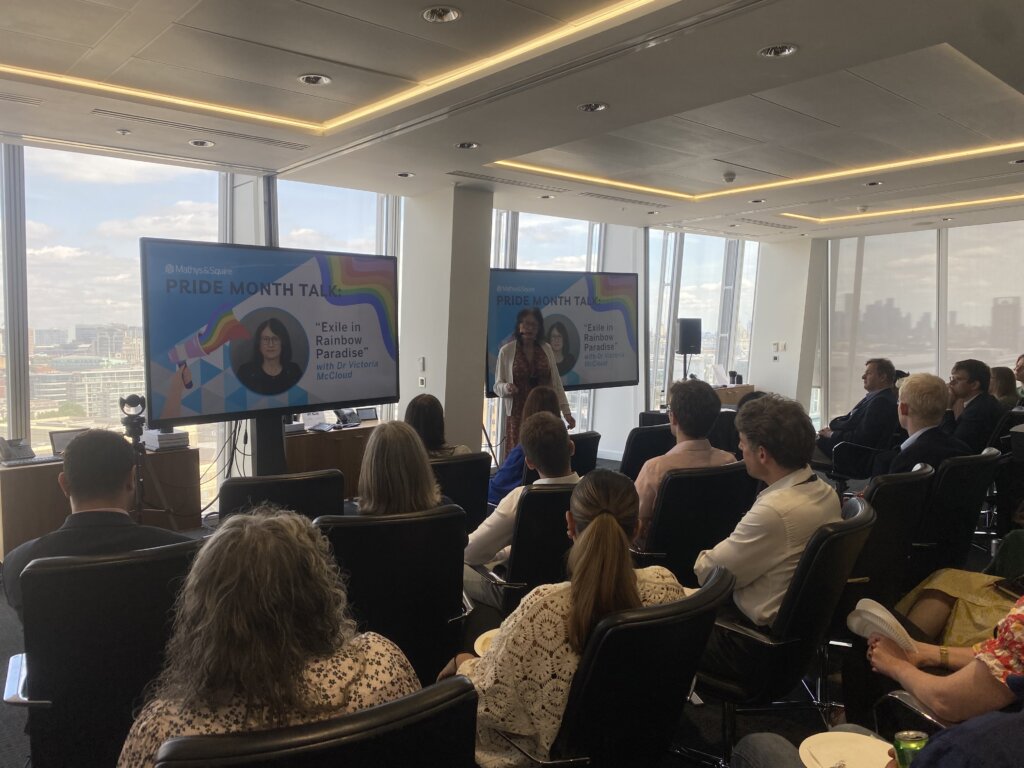
Victoria gave an educational and engaging talk which followed the timeline of her life whilst delving in to important topics, such as the nature of the UK legal system, changing attitudes towards gender, and her recent move to the “rainbow paradise” of Ireland. She also discussed the topical issue of how the rights of transgender and gay people are under threat in light of the recent Supreme Court Ruling. It was enlightening to gain an insight from someone with a deep understanding of both the law and the trans experience.
We are delighted to announce two new Partners and two new Managing Associates.
Mathys & Squire is delighted to announce a new round of senior promotions to its London office.
Harry Rowe and Dylan Morgan have been appointed as Partners. Helen Springbett and Tom Bosworth have been promoted to Managing Associates.
These appointments recognise their valuable contributions and leadership across Mathys & Squire’s trade mark, design and patent teams.
Harry Rowe is appointed Partner in London
Harry has over a decade of legal expertise specialising in trade mark law issues facing multinational corporations and SMEs. He works across a range of sectors including financial services, life sciences and automotive. Harry has a proven track record handling disputes, prosecutions and enforcement, including litigation. He is a recommended lawyer in the latest edition of The Legal 500.
Dylan Morgan is appointed Partner in London
Dylan has considerable experience drafting and prosecuting UK and European patents, managing global portfolios, and advising on infringement, licensing and IP strategy. He was previously an engineer at the Defence Science and Technology Laboratory. Dylan holds a master’s degree from the University of Cambridge, specialising in aerospace engineering.
Helen Springbett is appointed Managing Associate in London
Helen has extensive experience in patents and designs, specialising in the physics, mechanical engineering and materials science sectors. She has a wealth of expertise in medical informatics and devices, mechanical devices and nanotechnology. Helen holds a PhD in materials science from the University of Cambridge, specialising in the characterisation of quantum dots.
Tom Bosworth is appointed Managing Associate in London
Tom has significant experience in patent drafting, prosecution, and EPO oppositions and appeals. He specialises in cell and gene therapy, vaccines, antibodies, and genomics technologies. He holds a PhD in cardiovascular sciences from the University of Manchester. Tom previously worked in the biotechnology industry prior to his PhD.
Martin MacLean, a Senior Equity Partner at Mathys & Squire, says: “These promotions have all been well earned. Harry, Dylan, Helen and Tom are incredibly talented attorneys whose drive and hard work are an immense asset to our firm.
“We take pride in nurturing and developing our talent, and all four have consistently delivered the highest-quality work to our clients. I’m fully confident they will continue developing their practice and enhancing their expertise.
“We are very excited to welcome Harry and Dylan into our Partnership. Both will help lead our firm on a strategic level and play a crucial role in our growth plans.”
This press release has been featured in Law360 and New Law Journal.
This June marks Pride month, a time to celebrate the talent, creativity and innovation demonstrated by members of the LGBTQIA+ community, and reflect on the challenges and discrimination many would have faced particularly in their professional careers.
Whilst there has been progression over the years, it is no secret that we still live in a time where many are unable to feel empowered as their authentic self. Therefore, by acknowledging the following engineers and technical experts, we not only honour their scientific contributions, but also highlight the importance of visibility and representation. The following people serve as powerful role models to the next generation, inspiring and empowering others to pursue their ambitions with confidence and pride.
Frank Kameny (1925-2011)
Frank Kameny had a passion for astronomy from a young age, majoring in Physics in his degree at Queens College and completing his PhD later at Harvard University. He worked for the Army Map Service, working to develop and analyse astronomical maps during the conflict between the Soviet Union and the US. Unfortunately, he was fired shortly after it came to their attention that he identified as gay, and with his security clearance removed, he was no longer able fulfil this passion. In 1961, he became the first to petition the Supreme Court with a discrimination claim based on sexual orientation, and committed to being a LGBTQIA+ activist, organising protests and assisting others with their discriminatory law suits.
Sally Ride (1951-2012)
On 18 June 1983, Sally Ride became the first American woman to travel to space, as she completed her journey on the Challenger’s STS-7 mission. Beyond her vital work at NASA, she founded Sally Ride Science, a non-profit organisation which encouraged women to pursue STEM subjects. Sally had preferred to keep her identity as part of the LGBTQIA+ community private until after her death, in which she posthumously revealed that she had an intimate relationship with her working partner, Tam O’Shaughnessy. In 2013, the year after her passing, she was honoured with the Presidential Medal of Freedom by President Obama.
Edith Windsor (1929-2017)
In the 1960s, Edith Windsor was a pioneering computer programmer who exceeded in her career. She famously worked at IBM for 16 years, reaching the greatest possible position as a Senior Systems Programmer, a feat even more impressive as a woman in this era. She was an LGBTQIA+ activist and played a vital role in the Supreme Court case Windsor vs United States, in which she famously argued for a tax refund after the passing of her partner, which led to the court granting more benefits to same-sex couples. People often reference this as a turning point for same-sex couple in the US, and she is therefore remembered with the utmost respect. In 2013, she was a finalist for TIME magazine’s Person of the Year, and was described by TIME as “the matriarch of the gay-rights movement”.
Nergis Mavalvala (1968-)
Nergis Mavalvala is an astrophysicist who played a key role in the discovery of gravitational waves from the collision of two black holes. In his theory of general relativity, Albert Einstein had theorised this phenomenon, but it was Nergis and the rest of her team who were able to confirm this. Nergis has always been thoroughly committed to her education, completing her doctorate degree at the Massachusetts Institute of Technology in Astrophysics. She refers to herself as an “out, queer person of colour”, and dedicates herself to challenging discrimination in STEM.
Audrey Tang (1981-)
Audrey Tang is a computer scientist who first brought attention to their technological skill in 2014 during the Sunflower Protests in Taiwan as an open-source hacker, by helping to stream videos of the movement across the country. Tang later joined the ministry at 35, becoming the first ‘Digital Minister’ and Taiwan’s first transgender and non-binary minister. They have since been involved in revolutionary programmes, such as an educational initiative that helped equip young people with skills to identify fake news stories, as well as developing the ‘Mask Map’ during COVID-19, an online application which showed where masks were available to purchase during a national shortage.
At Mathys & Squire, we believe it is essential that everyone feels empowered to bring their full, authentic selves to work. We are deeply committed to fostering a workplace culture where diversity is celebrated, inclusion is prioritised, and everyone feels respected, valued, and supported.
Click here to read more about our Diversity & Inclusion policies.