World Environment Day 2026 is upon us, with its focus this year being on the direct action needed to tackle climate change. A cornerstone of this fight is the expansion of electrification using renewable energy, which comes hand-in-hand with battery developments capable of supporting this expansion.
For many applications, including the much-publicised electric vehicles market, Li-ion batteries are the prevailing energy storage means due to their established efficacy, excellent energy density and cycle life. However, as the electrical revolution progresses, innovation in energy storage solutions is being driven by the host of new applications and situations which electrical implementation must now account for. For instance, sodium-ion batteries have the potential to perform better than Li-ion batteries under lower temperature conditions, avoiding the significant drops in capacity and charging/discharging issues at lower temperatures (e.g. below 0 °C).
Clearly, batteries are an increasingly fundamental technology underpinning most, if not all, aspects of modern life; that is why investment and innovation is of great importance. And there are signs that advanced battery technologies are starting to make the leap from the lab onto the road. Earlier this year, the first passenger vehicle to be mass-produced with a sodium-ion battery was announced. An electric vehicle using a semi-solid-state battery (containing an electrolyte composition that is 95% solid) has recently been unveiled to be coming to the UK in late 2026.
As you might expect from a field with such significance to so many aspects of everyday life, there is a tremendous amount of activity on the patent front. In addition to being essential tools for protecting and commercialising your intellectual property, patents can also provide insights into the technological landscape of a given field. In this article, we’ll take a look at what the patent filing data for a selection of key cell chemistries says about the battery sphere today, and what it might suggest for the future.
Lithium-ion batteries
First released in 1991, the Li-ion battery has, with the help of some further significant developments, exploded in popularity (and only occasionally in aeroplanes) to become the most widespread of modern batteries due to their high energy density, efficiency and long lifecycle. Li-ion batteries have found utility across the spectrum of possible applications, from personal electronics to major components in electric vehicles (EVs). There are a number of cell chemistries that fall within the general category of “Li-ion battery”, varying most significantly in their cathode materials. These include: lithium nickel manganese cobalt oxide (NMC), lithium nickel cobalt aluminium oxide (NCA), lithium iron phosphate (LFP) and lithium cobalt oxide (LCO) cells.
Accompanying this boom in Li-ion battery adoption is a corresponding growth in patent applications in the field.
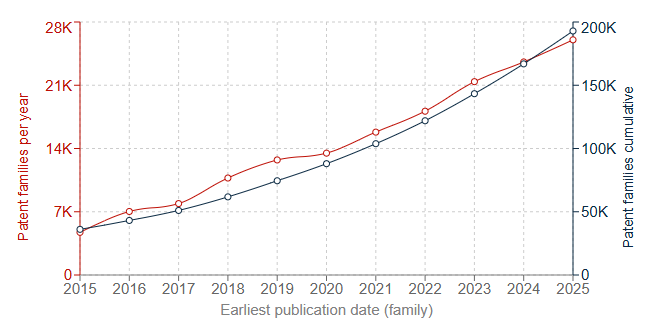
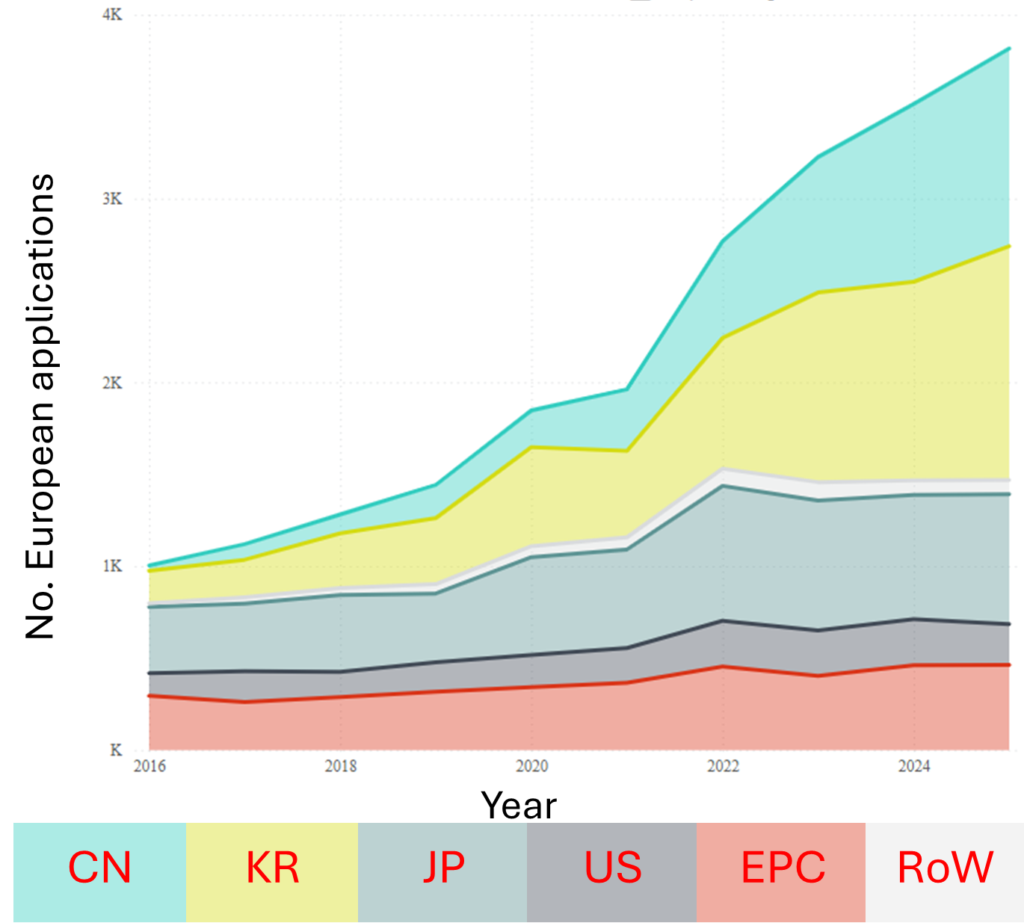
Fig. 1A shows the number of patent families published per year worldwide between 2015 and 2025 relating to Li-ion batteries. Fig. 1B shows the number of EP patent applications published between the years of 2016 and 2025 relating to Li-ion batteries, and includes a breakdown of these according to the applicant’s country.
As can be seen from Fig. 1A, the number of worldwide patent filings related to Li-ion batteries has grown steadily in the years between 2015 and 2025, reflecting their widespread adoption and development: in 2015, around 6000 patent families were published, contributing to a total cumulative number of around 40,000 patent families directed to this subject-matter. By 2025, this had increased to around 26,000 families published that year alone, and a cumulative number of patent families approaching 200,000.
Similar increases are apparent in EP applications, with a particularly notable rise in applications coming from Chinese and South Korean applicants in the past 5 years. Even though Li-ion battery technology, at a base level, has been around for quite some time, patent filings are clearly still growing, highlighting the keen interest and range of developments in the field.
However, one area of Li-ion battery technology that may still be in its (relative) infancy is recycling. In addition to the clear environmental benefits of recycling, Li-ion batteries contain several valuable elements, the efficient recovery of which is desirable from an economic standpoint. Given the typical lifespan of 10 to 20 years of Li-ion batteries and the increasing number reaching end-of-life stages in the near future, there may be a growing incentive to implement effective and economical recycling methods. The development of economical methods may be especially important for certain cell chemistries (such as LFP cells) which present more of an economic challenge due to the lower content of the more valuable elements, such as cobalt. While the number of patent applications directed towards such recycling methods seems to be growing year-on-year, it still remains a relatively minor portion of overall filings, with approximately 400 patent families published in 2025.
Sodium-ion batteries
Sodium-ion batteries are an emerging technology with significant potential for further innovation and applicability to current battery implementations. Whereas Li-ion batteries rely on lithium ions as charge carriers, sodium-ion batteries utilise (unsurprisingly) sodium ions. Otherwise, at least in their current forms, sodium-ion battery architecture is broadly similar to Li-ion battery cells, although the use of sodium ions allows for different electrode materials that often involve less expensive elements. For instance, current sodium-ion cells often employ layered transition metal oxide or Prussian white cathodes. Further cost benefits arise due to the abundance of sodium, as compared to lithium, as a key component, which can help to alleviate possible supply chain issues.
As already mentioned, sodium batteries also come with certain performance advantages over Li-ion batteries, albeit (at least at present) mainly only under specific conditions. In particular, sodium batteries can function effectively over a wider range of temperatures while maintaining good efficiency and capacity metrics that can be roughly comparable to Li-ion batteries under normal conditions.
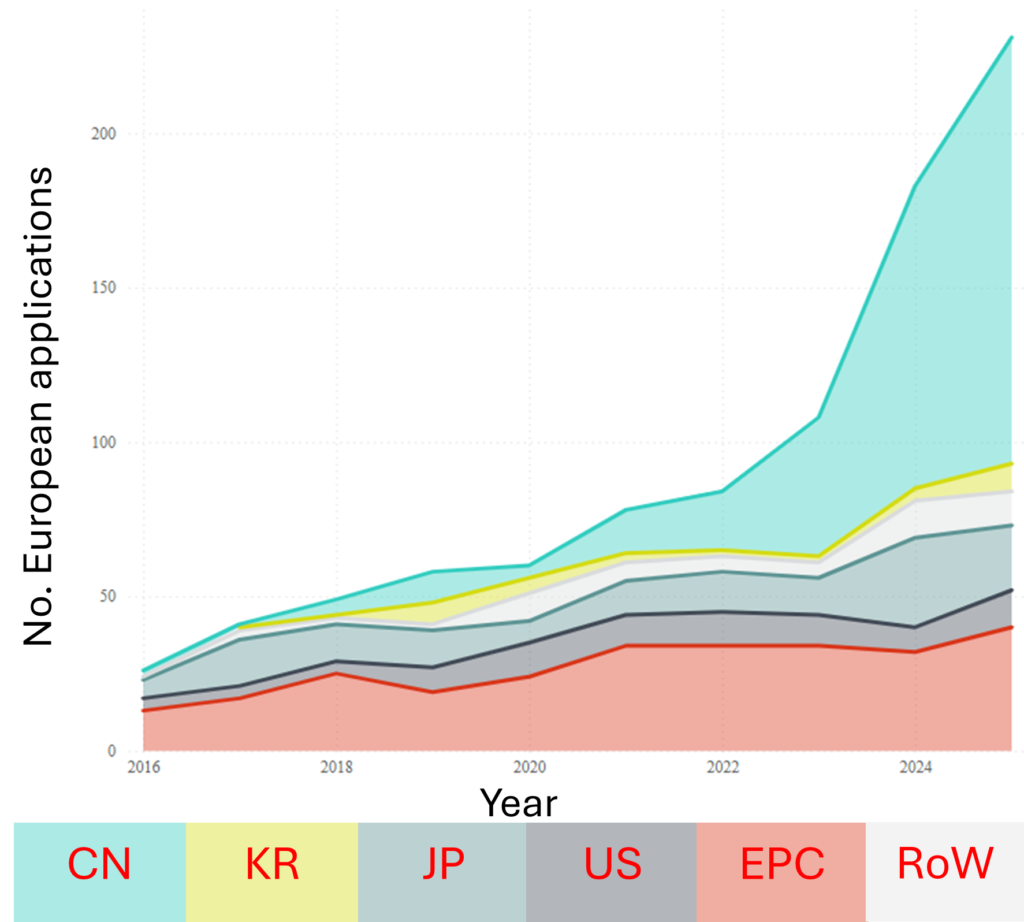
Although initial research into sodium-ion batteries roughly coincided with Li-ion batteries, the early promise of Li-ion cells caused their sodium-based sibling to fall by the wayside. However, commercial interest began to be renewed in the 2010s; this is reflected in the patent filings, as shown in Figs. 2A and 2B.
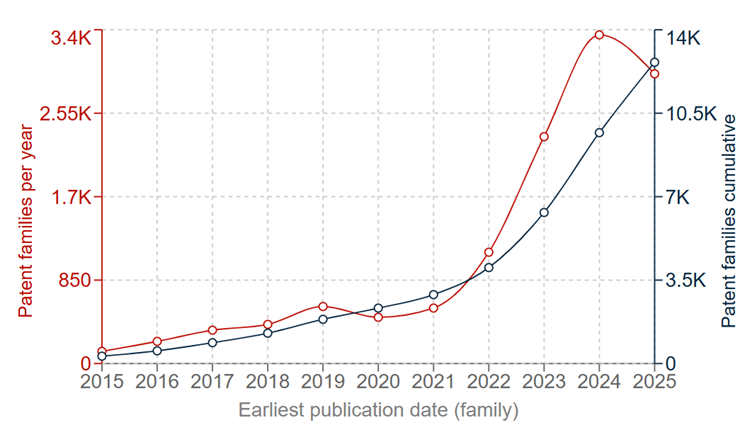
From only a handful of patent families published per year in the mid 2010s, patent filings grew steadily to about 500 patent families in 2021. From this point, there has been a surge in applications, with nearly 3,500 patent families filed in 2024 alone, adding to a cumulative total of around 10,000 families. It remains to be seen, however, whether the slight decline in 2025 represents a genuine cooling in interest, or simply a minor fluctuation.
Certainly, the EP filings show no decline in patenting activity, which is being driven primarily by China who are a clear frontrunner in sodium-ion cell chemistry. However, the sodium-ion battery field is one of the relatively rare situations where EPC countries are in a comparatively prominent position (in terms of filing numbers).
Comparing these numbers with the Li-ion data, patent filings for sodium-ion batteries are only at a similar level to Li-ion batteries in the early 2010s. This could point to there being plenty of potential for further innovation and development, particularly if their commercialisation is successful.
Lithium-sulfur batteries
Lithium-sulfur (LiS) batteries are developments of more typical Li-ion batteries, based on replacing the cobalt or iron-based cathode material with one consisting of S8 sulfur. In these batteries, lithium ions are stored as lithium sulfide (Li2S) during discharge, creating the potential for a cell with much higher specific energy than allowed for by the intercalation of Li-ions in conventional Li-ion cells.
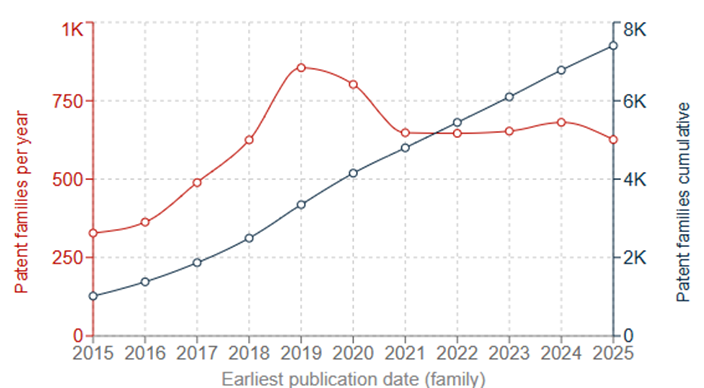
While the potential benefits from developing a successful LiS battery could be enormous, there are still barriers to overcome in the technology if they are to be successfully commercialised, such as electrode expansion and polysulfide shuttling. These barriers may be posing a challenge, or at least acting as a deterrent, since LiS battery technology appears to remain in its very early stages compared to conventional Li-ion batteries, despite the first LiS prototype batteries having been around since as early as the 1960s. This is reflected in the worldwide patent filings in Fig. 3A: from about 300 patent families published in 2015 of a cumulative 1,000 patent families, filings reached a peak of about 850 families in 2019 but have since diminished to a consistent number of about 600 patent families filed per year. These numbers are similar to those of Li-ion batteries over 20 years ago.
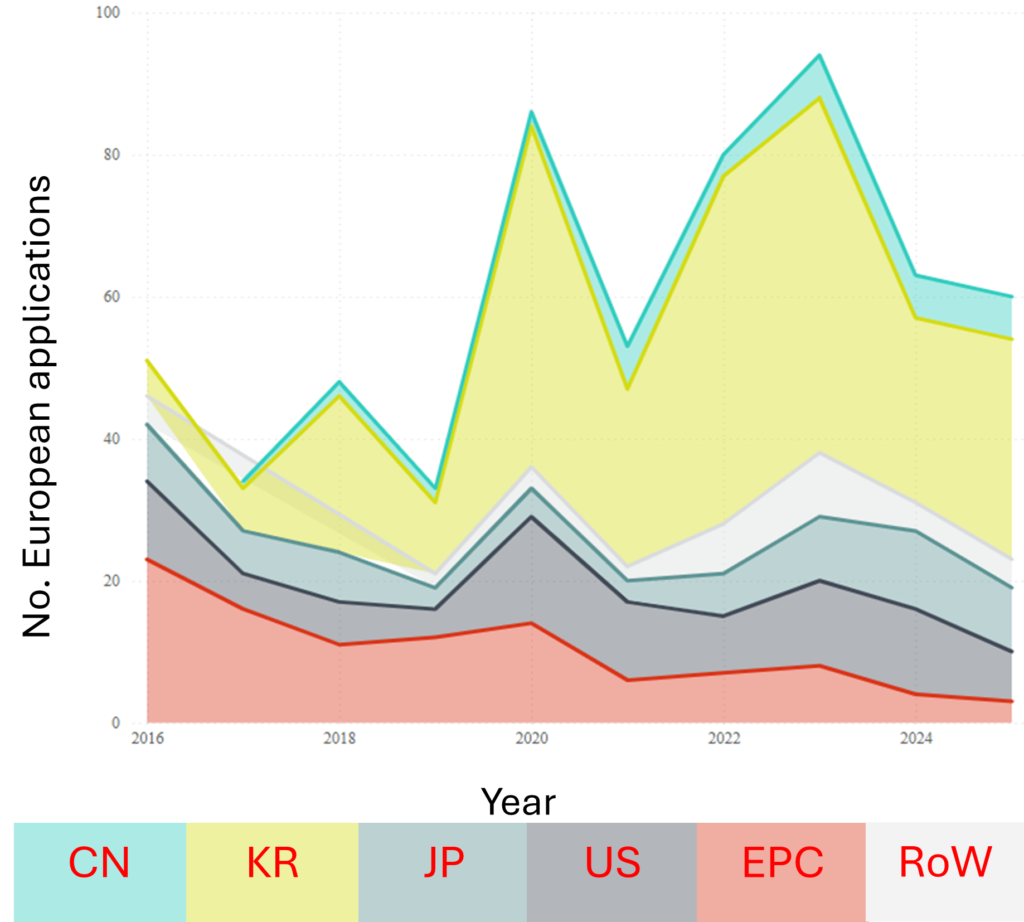
A lack of widespread adoption is also suggested by the EP data in Fig. 3B, which shows both a similar trend of declining applications in the past couple of years, and an overwhelming dominance in the field by South Korean applicants.
Solid state batteries
Conventional Li-ion batteries typically make use of liquid electrolytes, consisting of lithium salts in various organic solvents. However, solid state batteries aim to make use of a solid state electrolyte for conducting the charge carrying ions between the electrodes, which could provide significant improvements in terms of energy density and safety. Possible solid state materials naturally require high ionic conductivities, and a large variety of material classes to meet this requirement have been, and are currently being, explored. These include: polymer electrolytes; inorganic electrolytes such as oxide solid and sulfide-based electrolytes; and composite electrolytes that aim to incorporate aspects of both of these.
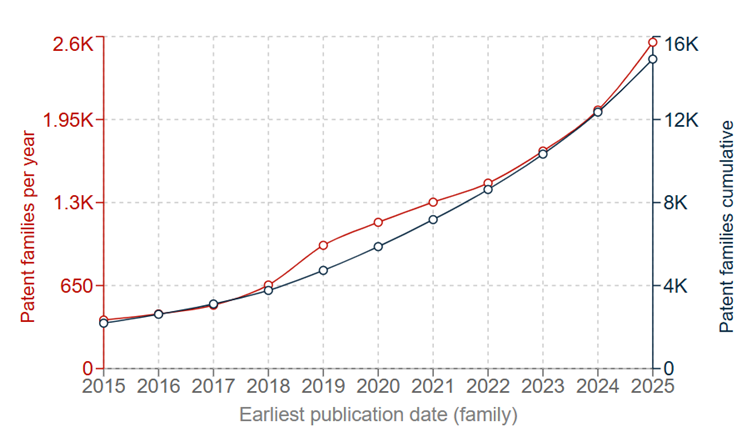
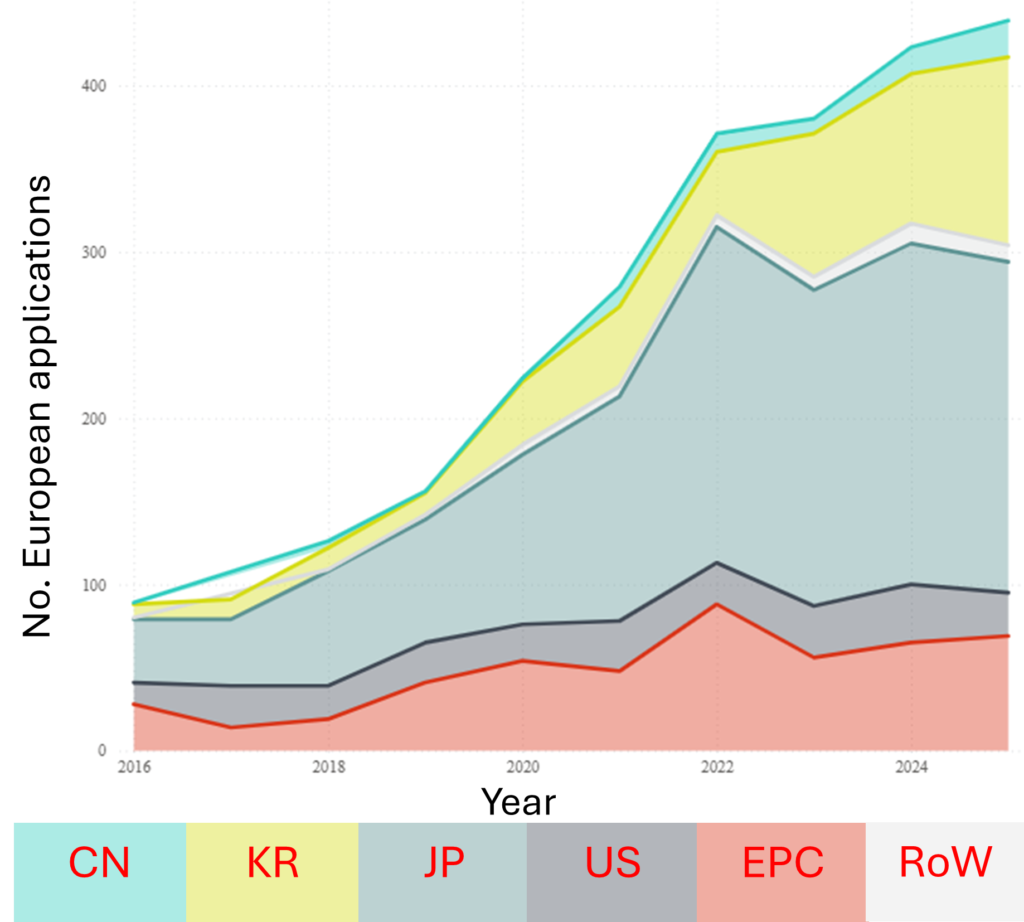
Growing demand for compact, safe, and high-capacity batteries across EVs and consumer electronics has seen solid state battery development start to approach manufacturing and early commercialisation. Correspondingly, the overall trend – both worldwide and at the EPO – is that of significant increases in filings. Although the technology is nowhere near as mature as general Li-ion batteries, and filings are currently only at a similar level to Li-ion batteries 15 years ago, patenting activity in solid state batteries is only likely to increase in the coming years.
Batteries and the clean energy transition
A crucial step to tackling climate change is moving away from fossil fuels and transitioning to net zero. To achieve this goal, we need to make a marked shift towards cleaner energy sources, such as solar and wind. However, there are obstacles which need to be overcome to ensure that these sources can provide sufficient power to fuel our ever-growing demand. Solar panels only generate electricity when the sun is shining. Wind turbines only generate electricity when the wind speeds are suitable. Therefore, this electricity must be stored and later released when supply falls or demand rises.
Innovation in battery technology is helping to solve this major challenge in the clean energy transition, providing a way to store energy and facilitating the widespread adoption of low-carbon electricity systems. Batteries are also essential in the electrification of transport which is another important measure for reducing greenhouse gas emissions.
Lithium-ion batteries currently play a major role in both electric vehicles and energy storage systems. Their relatively high energy density allows large amounts of energy to be stored in a compact space. On the other hand, sodium-ion batteries could be emerging as the holy grail of energy grids due to the greater availability of sodium. Although they store less energy per kilogram, this may not be of consequence for the storage of renewable electricity, and their relatively lower cost and reduced reliance on critical minerals could accelerate the clean energy transition. In terms of the electrification of vehicles, solid-state batteries may take us one step further. Whilst they are largely in a pre-commercial stage, it is suggested that they can offer a higher energy density, faster charging, improved safety and longer battery lifetimes. This could be revolutionary for vehicles like long-range passenger transport, heavy goods transport, or even aviatic and marine vehicles.
Patent strategy
Of course, there are far more possible battery technologies in development, and even more avenues for development, than have been discussed here. There undoubtedly remains a wealth of opportunity, across the entire field of battery development, for the discovery of the next transformative breakthrough.
However, as the data above indicates, there exists an extensive minefield of patent disclosures and patent rights. Is important to note that, despite the abundant prior art these patents represent, disclosures of broader subject-matter are not necessarily a bar to obtaining patent protection for further optimisations of that subject-matter. However, questions around freedom-to-operate would likely need to be answered. In such a busy field, navigating this maze of prior art and prior rights requires careful consideration and a comprehensive IP strategy.