Few sectors are as R&D intensive as the drug discovery and development industry. Considering also the complex regulatory hurdles that must be overcome to take a drug to market, any given asset typically requires 12+ years of development (at a cost of $M/Bs) before yielding a marketable product. This is a costly endeavour that requires significant investment.
By providing a framework that recognises and protects innovation at the earlier stages of the drug development journey, IP rights (notably patents) give companies and investors greater confidence that successful research may generate a return, helping to attract the capital needed to advance promising drug candidates through preclinical research, clinical trials and, ultimately, regulatory review. In this way, IP has helped bridge the gap between scientific discovery and commercial development. It supports the translation of ideas into practical innovations, enabling research organisations and startups to pursue ambitious projects that might otherwise struggle to secure funding.
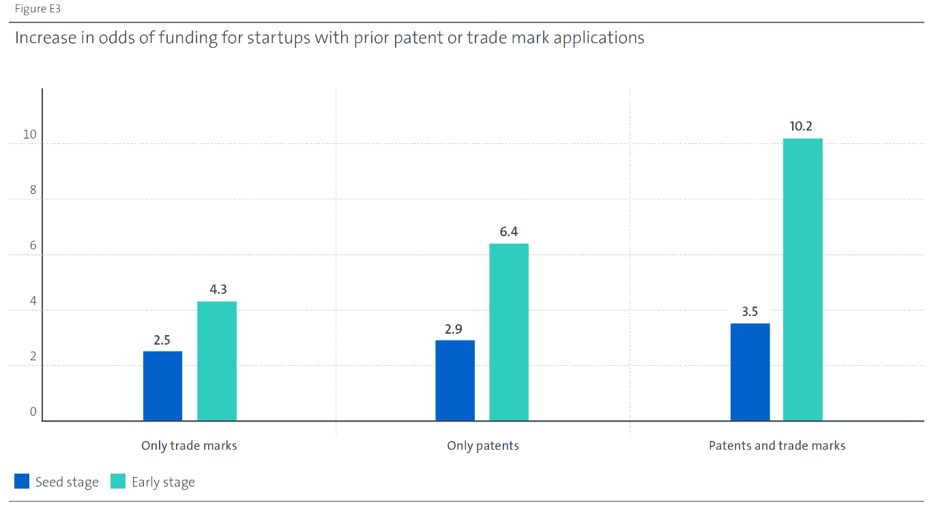
On the importance for attracting funding, an EPO and EUIPO study found that “startups with patents and trademarks are 10 times more successful in securing funding” while highlighting that biotech is “by far the most IP-intensive sector”. This is illustrated in Fig E3 of the study, copied below:
Below we discuss the importance of IP in enabling this industry, following which we outline some of our top-tips on becoming an investment ready startup/SME in the drug discovery space.
Enabling a thriving drug discovery startup ecosystem
Drug discovery and biotechnology startups, university spinouts and smaller research organisations are important sources of innovation, often developing novel targets, platforms, compounds and technologies that can reshape how diseases are understood and treated.
Unlike businesses that intend to build their own global manufacturing and commercial supply chains, many such ‘smaller’ drug discovery companies are established with a different business model: to develop promising technology and ultimately license it to, or be acquired by, a larger pharmaceutical company. Such transactions may take place when a candidate demonstrates sufficient promise in pre-clinical or early clinical development. A strong portfolio of patents and other IP can help demonstrate the value of an emerging technology, attract investment, support partnerships with established pharmaceutical companies and provide opportunities to license discoveries to organisations with the resources to develop them further.
This business model has attracted the attention of investors who can see the potential for a significant ROI upon a successful exit. Such investors are well aware of the role played by a strong IP portfolio in maximising exit valuations, and IP due diligence is thus a key component of investor decision making in this industry. Similarly, for prospective large pharmaceutical partners, IP protection is a fundamental consideration: a technology without appropriate IP protection may be difficult to license or acquire on commercially attractive terms.
Investment readiness requires more than having filed a patent application. A company must demonstrate that its IP strategy is integral to its business objectives, supports its development plans and creates a credible basis for future commercial opportunities.
1. Demonstrating a coherent and defensible IP portfolio
An investment-ready company should be able to explain its IP portfolio clearly and demonstrate how that portfolio supports its business plan. This requires an understanding of both the geographical coverage and the scope of the protection obtained or sought.
Geographical coverage and patent status
Companies should maintain an overview of the jurisdictions in which their IP is protected, explaining why those jurisdictions are strategically important. Investors will want to understand whether the portfolio covers the markets that matter to the business and its anticipated commercial partners.
The status of the relevant patent applications and granted patents should also be clear. Where the company has received citations or encountered challenges on a pending application, and successfully overcome them, explaining these developments may help demonstrate the progress, resilience and promising nature of its IP position.
Scope and practical strength of protection
The breadth of patent protection is equally important. Companies should understand precisely what their patents protect and whether competitors could develop alternatives that avoid infringement while achieving similar technical results.
For example, where protection relates to a lead compound, it is important to explain to investors whether the scope extends to related or so-called “me-too” compounds. Where protection relates to a method, the company should be ready to discuss with investors whether a competitor could design around the patent and, if so, how easily this might be achieved. A useful assessment is whether avoiding a protected technical step would require a competitor to sacrifice an important technical advantage or incur prohibitive costs. The objective is to understand whether the portfolio provides meaningful commercial protection rather than simply documenting an invention.
Evidence that the IP has commercial significance
Investors should also be shown that the company’s IP is more than a collection of patent documents. Evidence of its impact on the competitive landscape can strengthen the investment proposition.
Relevant indicators may include enquiries or licence requests from third parties, competitors changing direction after a patent application becomes public, or increased attention to the technology in academic literature following publication of the filing. Such evidence can help demonstrate that the IP is attracting interest, influencing activity in the field or creating opportunities for commercial engagement.
2. Building an IP roadmap around research and development milestones
Investors expect an IP strategy to evolve alongside the company’s research and development (R&D) programme. Rather than treating patent filing as a one-off activity, companies should plan how their portfolio will develop as the technology matures and new commercial opportunities emerge.
This may involve planning follow-on patent applications covering different aspects of a drug candidate, including:
- Composition of matter: protection relating to the compound itself.
- Formulation: protection relating to how the compound is formulated.
- Method of manufacture: protection relating to the process used to produce the compound.
- Specific therapeutic indications: protection relating to particular uses of the asset.
- Dosage regimens: protection relating to how the drug is administered.
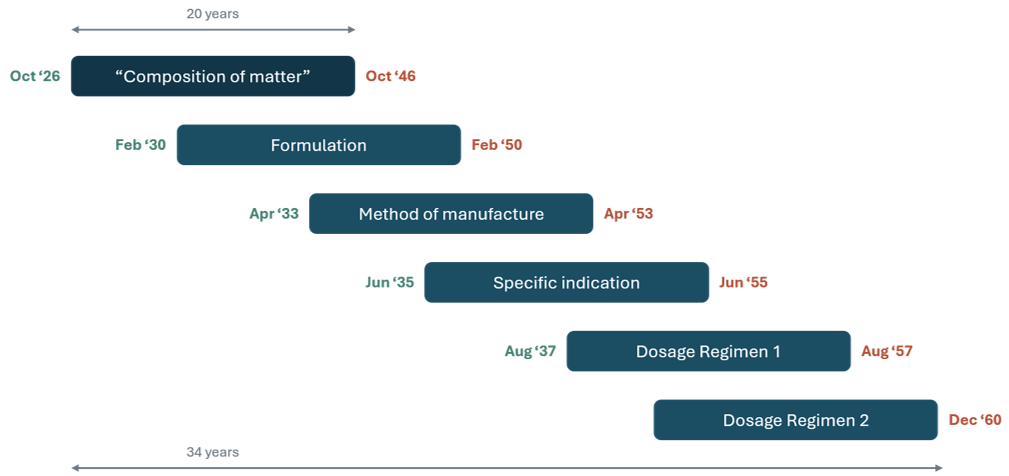
These different categories of protection may arise at different stages of development. The company’s IP roadmap should therefore identify potential follow-on applications and align them with anticipated R&D milestones and the generation of supporting technical evidence. The purpose is to continue developing the IP estate as the underlying science progresses. Additional protection relating to the form, manufacture or use of an asset may be directly relevant to how that asset is ultimately marketed, potentially supporting further periods of exclusivity.
A very generic ‘example’ roadmap, starting from a first filing date (green) in Oct ’26 directed to a “composition of matter” with an expiration date (red) in Oct ’46, may look like this:
Working with patent attorneys to establish and maintain an IP roadmap can help ensure that the company’s patent strategy remains connected to its scientific achievements, development priorities and longer-term commercial objectives.
3. Identifying and managing third-party patent risks
We do not live or work in vacuo and any science that is worth pursuing can be expected to attract others too in the form of competitors.
A credible IP strategy must address not only the company’s own patent portfolio but also the rights held by other organisations/ third parties. Investors will want reassurance that the business understands the surrounding patent landscape and has a plan for managing potential obstacles to development and commercialisation.
Freedom to operate
A freedom-to-operate (FTO) assessment considers relevant third-party IP that may affect the company’s ability to pursue its intended activities. The objective is to identify potential risks and develop an appropriate response.
Where relevant third-party rights are identified, possible risk-mitigation approaches may include designing around the protected technology or seeking a licence. Demonstrating that the company has considered these options signals a proactive approach to protecting risk against investors’ capital.
Importantly, no search can guarantee that a dispute will never arise. Investment readiness therefore also involves considering how the company would respond if a patent dispute emerged. The assessment of third-party rights should be revisited over time as the industry landscape and the company’s own development plans evolve.
The company’s position in relation to competitors
The analysis should also consider the reverse situation: whether the company’s own IP creates a position that competitors may need to address.
A strong or dominant patent position may require third parties to seek a licence and can provide leverage in cross-licensing negotiations. Understanding this position helps a company assess the strategic significance of its portfolio and explain how its IP may influence relationships with competitors and potential partners.
Together, these assessments demonstrate that the company is considering both the risks to its freedom to operate and the commercial opportunities created by its own IP rights.
4. Establishing clear ownership and control of IP
Even a technically strong patent portfolio may present difficulties if ownership is unclear or the company lacks the necessary rights to exploit it.
An investment-ready business should be able to demonstrate a clear chain of ownership and identify any contractual restrictions that could affect the use, licensing, assignment or management of its IP.
This is particularly important for companies that have developed technology through collaborations or with the involvement of consultants and external development partners. The relevant contracts should contain appropriate IP provisions, and the company should understand who owns the resulting inventions and other IP.
University spin-outs may face additional considerations where the IP remains in the name of the original institution or another legal entity from which the business was established. In such circumstances, the company should understand what steps are required to transfer ownership or secure the rights needed to exploit the technology.
Joint ownership can also create complications. Investors will want to know whether third-party consent is required for key activities, including licensing, assigning or amending a patent or patent application. Reliance on another party’s approval can introduce uncertainty and potentially delay a transaction.
Where ownership needs to be transferred, the company should be able to explain the proposed assignment and how it will be achieved. The central objective is to ensure that the company has the legal and practical ability to control and exploit the IP on which its business depends.
5. Aligning IP strategy with commercial opportunities
Investment readiness is not solely about protecting technology. It is also about demonstrating that the IP portfolio is relevant to potential commercial partners.
Companies seeking investment should consider which organisations may be interested in licensing or acquiring their technology and whether their IP strategy is aligned with those organisations’ commercial priorities.
For example, a company may hold an asset that complements an existing pharmaceutical pipeline or addresses a potential gap created by an impending patent cliff. Alternatively, its technology may provide an opportunity to develop a new therapeutic indication for an existing drug, creating an additional revenue stream for a prospective partner.
These possibilities can make the company a more attractive candidate for collaboration or acquisition, particularly where the technology addresses a clearly identifiable strategic need.
Companies should therefore consider their target partners when developing their IP portfolios. The relevant question is not simply whether the technology can be protected, but whether the protection supports an opportunity that another organisation may value.
By proactively creating partnership opportunities, a company can demonstrate that its IP strategy is connected to a realistic commercial pathway rather than operating independently of its growth and exit plans.
6. Using trade marks to support long-term commercial value
Trademarks are another important component of investment readiness. Their role extends beyond registering a product name: they can form part of the company’s broader business and marketing strategy.
In the pharmaceutical sector, the commercial value of a drug may continue long after its patent protection (including any extensions) has expired. During the period in which patents are in force, exclusivity can help a product establish market momentum. Once generic competition becomes possible, prices may fall in the absence of patent protection.
A well-considered branding strategy, supported by trademarks, can help sustain that momentum. A recognised brand may benefit from goodwill associated with a product that customers regard as reliable, trusted and proven.
Customers may continue purchasing a familiar product identified by its trademark, at least until generic competitors have had time to establish their own credibility.
Trademarks should therefore be considered as part of the wider IP and commercial strategy. While patents and trademarks perform different functions, together they can contribute to the company’s approach to protecting and developing the value of its assets throughout their commercial life.
Making IP a core business objective
Investment readiness from an IP perspective requires a company to demonstrate that its intellectual property is strategically managed, commercially relevant and capable of supporting its development and growth plans.
For drug discovery start-ups, SMEs and spin-outs, this means going beyond the existence of patent applications. Companies should be able to explain the geographical coverage and scope of their protection, demonstrate how their IP roadmap aligns with R&D milestones, identify and manage third-party patent risks, establish clear ownership and show how their portfolio may create opportunities for licensing or acquisition.
Trademarks should also be considered within the broader commercial strategy, particularly where brand recognition may contribute to value beyond the period of patent exclusivity.
Ultimately, investors need confidence that the company understands the value of its IP, the limitations and risks associated with its position, and the steps required to turn its technology into a commercially attractive opportunity. By treating IP as a core business objective, rather than a purely legal or administrative function, a company can present a more coherent investment proposition and build a stronger foundation for future partnerships and exit opportunities.
If you require assistance getting your IP portfolio and strategy ready for investor due diligence, please reach out to us here.