London Fashion Week, which took place at the end of February, is one of the most influential events in the global fashion calendar, bringing together designers, brands, buyers and media from around the world.
In recent years, the event has also become an important platform for discussions around sustainability and innovation in textiles, and so it is no surprise that London Fashion Week is taking a leading role within the fashion industry by introducing stricter environmental standards, supporting sustainable designers, and promoting innovative materials and circular fashion practices.
This year was the first year in which the British Fashion Council formally adopted Copenhagen Fashion Week’s Sustainability Requirements for designers supported by NEWGEN, a talent incubator offering the chance to showcase at London Fashion Week. London is the first of the four ‘fashion capitals’ to implement the framework, and it was also the first Fashion Week to ban real fur and animal skins.
Like in many industries, the transition to more sustainable practices within the fashion industry presents major challenges, but it also creates significant opportunities for innovation. One exciting area of innovation is in the development of biomaterial-based textiles. Biomaterials offer sustainable and biodegradable alternatives to petroleum-based synthetic fibres, but several challenges must be overcome before their commercial potential can be realised.
The science of biomaterials
Biomaterials for use in textiles are typically made from naturally occurring biopolymers which can be extracted from or synthesised in living organisms, such as bacteria, plants, algae and fungi. Biopolymers often possess inherent properties which make them particularly well suited to the manufacture of fibres and fabrics, such as high tensile strength, elasticity and durability. For example, microbial silk (polymeric amyloid) fibres have been produced which exhibit greater strength than natural spider silks, and these microbial silk fibres have already been used to produce garments, such as silk ties and designer dresses. Fungal-based materials have also been developed which exhibit comparable properties to leather, while also being environmentally friendly and vegan.
The ability to produce biopolymers in biological systems provides a plethora of advantages. Microbial‑based biopolymer production enables rapid and controlled production from renewable starting materials, such as glucose, plant sugars or agricultural waste. Microbes can also be engineered to modify the existing properties and introduce entirely new properties to the biopolymers, e.g. inherent colour properties.
Although biomaterials offer significant environmental benefits, several challenges currently inhibit their widespread adoption. For example, production costs are typically much higher than for petroleum‑based synthetic fibres, such as polyester, which benefit from pre-existing and well‑established petrochemical processing infrastructure. Similarly, while production of small amounts of biopolymer can often be readily achieved in the lab, scaling production processes to the levels required for industrial production can be slow and costly.
These challenges must be overcome before biomaterial-based textiles are widely available, and at costs acceptable to the typical high street consumer.
Biomaterials at London Fashion Week 2026
While scientists and engineers work to overcome the challenges outlined above, top designers are already embracing biomaterials and London Fashion Week provided the perfect opportunity to display their work. A few of our favourites from London Fashion Week 2026 are highlighted below:
- Vin + Omi are British eco-designers with a reputation for transforming waste materials into high-fashion articles. Their London Fashion Week collection included pieces made from holly, nettles, butterbur and wood clippings. A particular highlight was a suit crafted from holly trimmings taken from King Charles’ Sandringham Estate. Cellulose was extracted from the holly and spun into fibres which were then dyed with beetroot. This isn’t the first time Vin + Omi have made use of waste from the Royal Estates, they previously exhibited a collection of 26 garments in an exhibition called “Royal Garden Waste to Fashion’s Future”.
- Genaro Rivas is a Peruvian Designer who emphasised regenerative biomaterials in his London Fashion Week collection (“A Glass to Break”). The materials used in his work included textiles made from regenerative fibres which play a role in actively restoring wetlands and reducing reliance on feather and synthetic fillers, leather made from upcycled banana crop waste, and plant‑based fur.
- Stella McCartney headlined London Fashion Week with a curated collection celebrating sustainable British material innovation. The collection included plant-based alternatives to feathers, mycelium-based leather substitutes and biobased, plastic-free sequins.
Protecting biomaterial-related innovation
For innovators looking to develop new biomaterials or new production processes, patents provide a powerful tool to protect their innovation and support their commercial development. As with any technology, the existence of a patent portfolio can help to attract investors and can provide a commercial advantage over competitors who might be looking to work in a similar area.
The key patentability considerations for biomaterial-related patent applications are the same as for any type of technology area, i.e. the invention must be novel, non-obvious and industrially applicable. Given the wide range of technical challenges in this area, there are a large number of ‘technical problems’ which can be overcome to demonstrate non-obviousness. Data which demonstrate that the newly developed biomaterials and/or processes are superior to those which are already known are very helpful in this regard. For example, a patent application may demonstrate that a newly developed biomaterial exhibits improved properties (e.g. improved flexibility, durability, tensile strength or water resistance) or that a newly developed process can be scaled to an industrial level without sacrificing the quality of the biomaterial.
While the first patent filing is often the most important, it is essential that technical advancements made while developing new biomaterials and processes are well recorded, and that the patentability of these advancements is considered in their own right. It may be commercially astute to retain some of these developments as trade secrets, but it is important that key technical developments which will be published (or which could be derived from the product) are properly protected by registered IP. The continual development of a patent portfolio will ensure that commercial products are robustly protected.
Conclusion
The science behind biomaterials is rapidly evolving, and overcoming existing challenges will involve multidisciplinary solutions which combine biology, chemistry, materials science, biotechnology and industrial engineering to create sustainable textile alternatives. As research advances, biomaterials are likely to play a major role in reducing the environmental footprint of the textile industry and it may not be long before they become a staple of high street fashion brands.
Mathys & Squire have extensive experience working with clients to protect their biomaterial innovations, supporting highly successful sustainable fashion companies, such as Colorifix. If you would like to find out more, please get in touch with a member of our team via our enquiry form.
Mathys & Squire sponsored the Non-Law into Law Conference for the third year running, with this year’s conference taking place on the 18th of March at the London School of Economics. Partners James Pitchford and Anna Gregson, and Technical Assistant Louis Brosnan all spoke at the event.
The Non-Law into Law (NLIL) Conference is designed for students across a range of academic disciplines, to give the attendees insights into a variety of pathways into legal careers, even though they are not currently studying law.
The conference has been growing every year, with over 300 students now taking part, who engage in a series of panel discussions, presentations and workshops given by experienced lawyers and current trainees in areas such as commercial law, finance law, and Intellectual Property (IP).
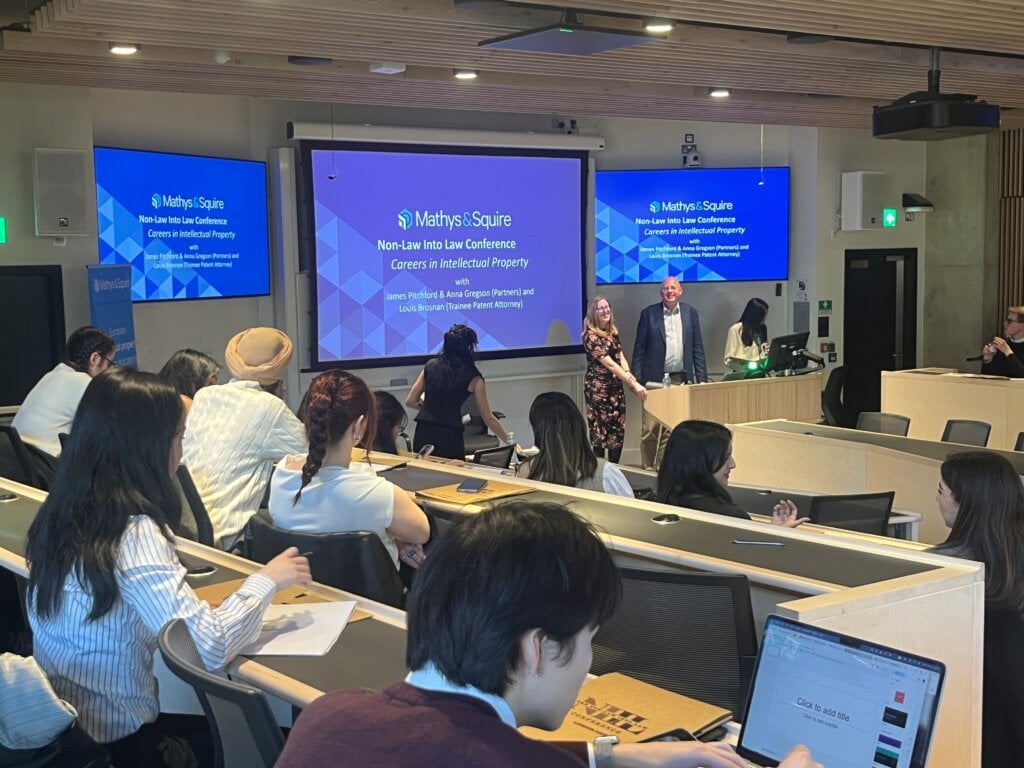
The team from Mathys & Squire led three events in relation to IP, including a workshop specifically focused on the patent attorney career, aimed at STEM students, and a panel session on careers in IP, for students from all subject backgrounds. The team also ran an interactive IP workshop which provided practical insights into the work of patent and trade mark attorneys, including identifying and capturing IP, and protecting innovations by means of patents, trade marks, registered designs and copyright.
It was a pleasure to attend this year’s event and to highlight the exciting opportunities available in IP professions for graduates and postgraduates. Our team also enjoyed engaging with the enthusiastic attendees and answering their questions on a range of relevant topics, including in respect of developing technical writing skills and the use of AI.
Research from Mathys & Squire on the number of patent applications for anti-drone devices has been featured in the article, “Trial by fire: ‘no training’ to prepare for reforms”, by The Times.
Partner Andrew White has also been featured in a number of publications, following his commentary on the growing demand for technology which defends against drones, as drones become a mainstream security challenge rather than just a niche concern. He notes that the conflict in the Gulf demonstrates a need for anti-drone measures which are not dependent on the use of million-dollar interceptor missiles and will push innovation towards non-traditional approaches.
Publications
- South China Morning Post
- Compare the Clouds
- The Daily Star
- ePlane AI
- The Star
- La Nouvelle Tribune
- Tech Round
- Unmanned airspace
- 24 News HD
- Macau Business
- Kompas.com
- Vietnam plus
Read the extended press release below.
- Number of applications rose by 27% to 126 in the year to March 2025, up from 99 the year before
- Drones have transformed modern warfare in Ukraine
- Conflict in the Gulf shows the limits of using pre-drone era expensive interceptor missiles
The number of patent applications for anti-drone (counter-UAV) technologies filed globally increased by 27% to 126 last year*, up from 99 the year before, according to new research from leading intellectual property (IP) law firm Mathys & Squire.
The sharp rise in patents filed reflects growing global demand for systems capable of disabling or neutralising drones, whose use has expanded rapidly.
The conflict in the Gulf shows the need for anti-drone measures that aren’t dependent on the use of million-dollar interceptor missiles. Meanwhile, incidents involving suspicious drone sightings in Europe and the US over the past year have raised questions about the vulnerability of both domestic civilian and defence infrastructure to drone attacks.
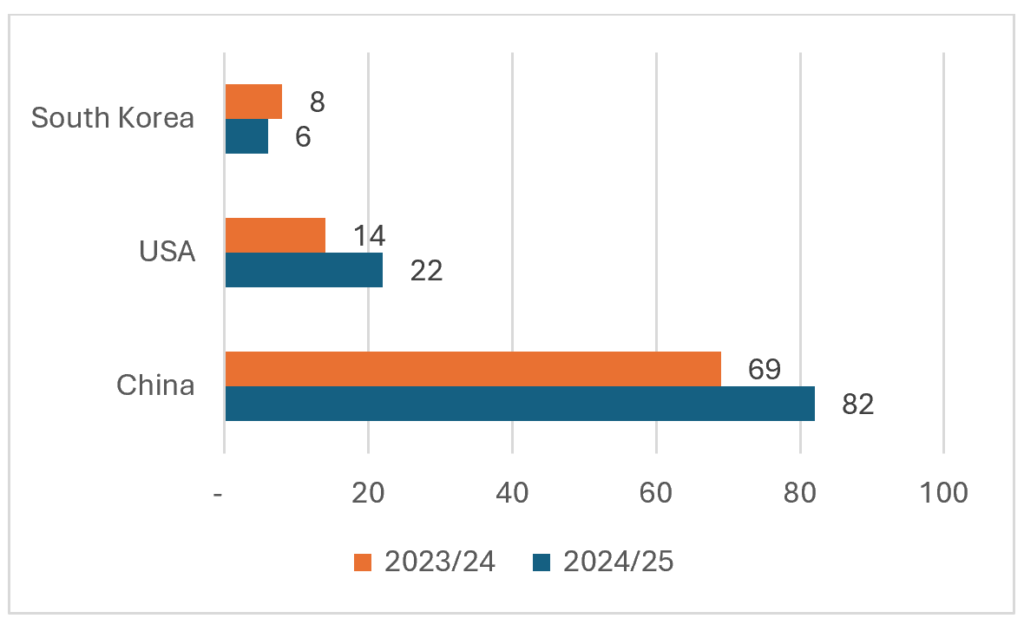
China dominated the global anti-drone patent landscape, filing 82 applications in the last year alone, far ahead of the US, which recorded just 22 new anti-drone patent submissions. China, the US and South Korea rank as the top three anti-drone patent filers globally.
European filers appear to be lagging in anti-drone patent filings, despite the fact that since September, seven major European airports have faced drone-related disruptions, including major hubs such as Brussels and Munich.
Interference and jamming remain the most common area of innovation, recording 49 new patents last year. Signal interference technologies accounting for the largest share of new inventions. This reflects a growing focus on non-kinetic countermeasures designed to disrupt drone communications and navigation systems.
Following recent drone-related incidents – including the temporary suspension of operations in Copenhagen and Oslo airports – technologies that can rapidly disable or disrupt drones, such as signal interference, appear to be in increasing demand.
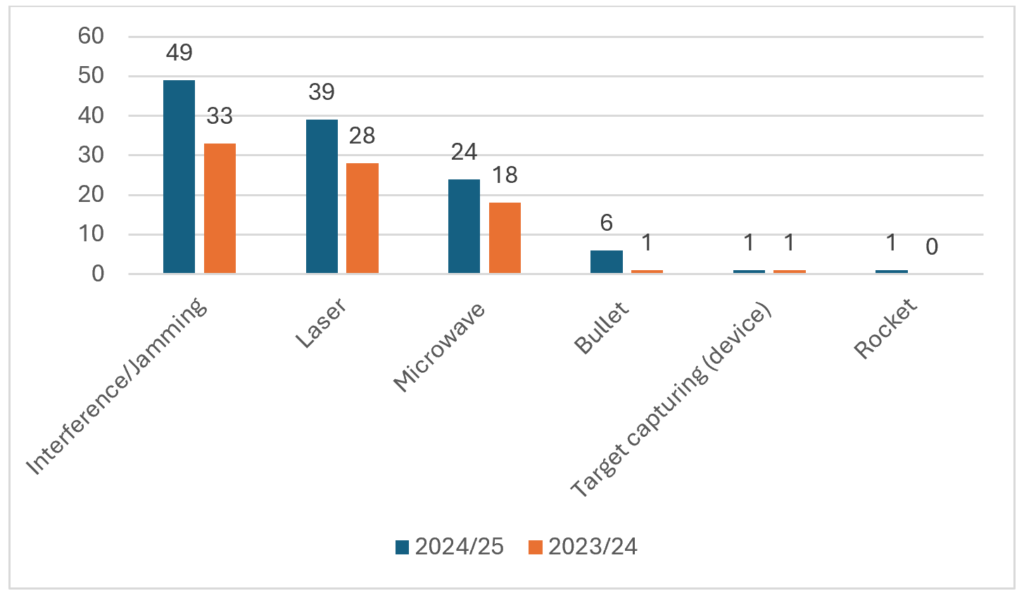
However, a notable shift is also underway toward next-generation counter-drone technologies. Laser-related inventions reached 39 in 2025, while microwave systems rose strongly to 24 patents, suggesting increasing interest in directed-energy approaches as part of future airspace security.
Andrew White, Partner at Mathys & Squire says: “Drones have shifted from being a niche concern to a mainstream security challenge and the rise in patent filings reflects that change. With drone disruptions affecting sensitive sites and infrastructure, organisations are racing to develop reliable countermeasures.”
He adds: “We’re also seeing innovation move beyond traditional approaches. Laser and microwave systems are gaining traction in the counter-drone market and this is likely just the beginning of a broader shift in how airspace threats are countered.”
Commercial and infrastructure protection use cases are also growing rapidly, with anti-drone technologies increasingly being developed for use in areas such as airports, prisons, energy infrastructure, ports and large public events.
*Research conducted with a year-end of March 31, 2025
Partner Claire Breheny has been featured in “Who owns a name? Katy Perry, Estée Lauder and Jo Malone test rights” by the World Intellectual Property Review (WIPR).
The article emphasises the tensions which can arise between personal identity and trade marks, delving into two recent developments in trade mark disputes: Katy Perry losing against fashion designer Katie Taylor (born Katie Perry) and Estée Lauder filing a claim against Jo Malone over the use of her name in a collaboration with Zara.
Claire’s commentary contributes to the common debate, which is particularly relevant to celebrity branding, over who owns a name, highlighting how the own-name defence in the Trade Marks Act 1994 can be overridden by contractual obligations.
Read the article in full here.
The European Patent Office (EPO) has confirmed that a number of its official fees will increase from the 1st of April 2026, following a decision of the EPO Administrative Council in December 2025. The updated fee schedule was published in the January 2026 issue of the Official Journal.
Overall, most affected fees will increase by around 5%, reflecting the EPO’s return to a biennial inflation-based review of official fees.
Key fee changes
The increases apply to a few commonly incurred fees during European patent prosecution. These include:
- European search fee increasing from €1,520 to €1,595
- Examination fee increasing from €1,915 to €2,010
- Designation fee increasing from €685 to €720
- Grant and publication fee increasing from €1,080 to €1,135
- Claims fee (16th – 50th claim) increasing from €275 to €290
Renewal fees payable during the application stage will also increase by approximately 5%.
Fees remaining unchanged
Not all official fees will be affected by the increase. The following fees are some which will remain at their current levels:
- Filing fees (including online filing)
- Additional page fees
- Opposition fees
- Appeal fees
This means that the most significant changes primarily affect core prosecution and renewal stages of the European patent process.
When the new fees apply
The revised fees will apply to payments made on or after the 1st of April 2026. This means that applicants may be able to reduce costs by paying certain fees before that date where the rules allow early payments.
There will also be a six-month transitional period. If a fee is paid at the previous rate after the 1st of April, the payment will still be accepted provided that any shortfall is paid within two months of the EPO requesting it.
Practical considerations for applicants
Given that many prosecution and renewal fees are increasing, applicants may wish to review their portfolios ahead of April 2026. In some cases, it may be possible to pay upcoming fees early to secure the current lower rates, depending on the applicable deadlines and payment rules.
Please reach out to us here if you have any queries.
International Women’s Day, which took place this Sunday, the 8th of March, celebrates the achievements of women throughout history and the progress they have made in achieving equal rights to men, socially, culturally and economically.
2026 marks an incredible milestone: 115 years of International Women’s Day. Those 115 years have seen many important advances for women; however, there is still a long way to go. Women still face discrimination, lack of representation and disadvantages across many areas of daily life, such as in the workplace, in healthcare and in their relationships.
In acknowledgement of IWD, we will be showcasing an inspiring client who are improving women’s quality of life through scientific innovation. At Mathys & Squire, we are proud to have the opportunity to not only help our clients to protect their inventions but also support them in an entrepreneurial journey which will have a wider positive impact on society.
Epowar – Women’s Safety App
Epowar was founded in 2020 by University of Bath students, E-J Roodt and Maks Rahman, driven by the need to transform women’s safety and enable them to live their lives free from fear.
The rate of femicide has remained consistent for the last decade, with one woman killed in the UK every three days, and Violence against Women and Girls (VAWG) was declared a national emergency in 2024. It is no surprise that girls and women are raised to be on constant alert. “Don’t walk back on your own.” “Don’t go on a run at night.” “Don’t forget to text me when you are home”. Most men wouldn’t give a walk home from the station at 10pm a second thought, but, for women, it is twenty minutes of unease and agitation, or something to be avoided completely. If something does happen, you can call the police on your phone, but what if it is not to hand? You can activate a rape alarm, but what if there is no one there to hear it?
Instead, Epowar’s patented ‘Automatic Attack Detection’ technology connects to your smartwatch, harnessing AI, and tracking your heart rate and motion to automatically recognise when you are in danger. If an attack is detected, the Epowar app gives you quick and easy access to 999, and sends an automatic notification to your friends so they can call for help if you are unable to.
Another feature of the technology is the ‘Evidence Pack’: a cache of evidence stored in the cloud, including audio, location and time stamps, can be accessed even if the phone is stolen or destroyed.
“Epowar exists because every woman has a story,” says founder, E-J. Whilst 97% of women in the UK have been harassed or assaulted, the percentage of women who press charges is significantly smaller, and the percentage of charges which end in conviction is even smaller. With concrete evidence, Epowar empowers women to take the brave step towards reporting the crime and, ultimately, helping protect other women as well as themselves.

“It has been a privilege to support Epowar through the entire patenting process for their attack detection technology, and we are proud to share that they were recently granted a UK patent.”
William Wathey, Associate

“Running Epowar has been an incredible experience, and having our attack detection patents approved in the UK and US were two of the biggest highlights of the journey so far. We set out to create something innovative to empower women to feel safe while they move through the world, and we believe now more than ever that tech will play a powerful role in tackling this global crisis.”
E-J Roodt, Founder of Epowar
Visit Epowar’s website to learn more here.
Partner Claire Breheny and Trainee Trade Mark Attorney Tanya Rahman have been featured in Trademark Lawyer magazine with their article, “The battle of brand Beckham,” as the cover story of the first issue of 2026.
The article explores how Brooklyn Beckham’s claims about being pressured to “sign away” his name has cast a light on the legal issues which can come into play when a name or family achieves the status of its own brand. Claire and Tanya discuss how it is not uncommon for personal names to be registered as trade marks, and why careful management and enforcement is so important.
Read the article in full here.
Partner Nicholas Fox has been featured in PLC Magazine with his article, ‘AI patentability: rift healed but questions remain,’ discussing the decision by the Supreme Court earlier this month in Emotional Perception AI Ltd v Comptroller General of Patents, Designs and Trade Marks.
The article places the Supreme Court’s decision in the context of how the assessment of the patentability of computer inventions in the EPO and in the English Courts has developed since the 1980s.
Nicholas Fox comments that the Supreme Court’s latest ruling has restored a harmony between the UKIPO and EPO, with the EPO’s “any hardware” approach to the assessment of patentability now to be followed in the UK. The Supreme Court has also modified how novelty and inventive step are to be assessed in the UK so that only aspects of an invention which provide a technical contribution to the prior art will now be taken into account when assessing novelty and inventive step similarly to how they are assessed in the EPO.
Read the article in full here.
This article first appeared in the March 2026 issue of PLC Magazine.
Partner Edd Cavanna and Technical Assistant Daniel Speed have written an ‘Expert Analysis’ chapter for the inaugural Global Legal Insights Special Report – Quantum Computing 2026.
Their article, “IP in the quantum industry: a global perspective on patent procurement,” highlights how the rapid innovation in the field of quantum has triggered notable growth in the intellectual property ecosystem, and how a robust framework for IP protection is essential for the viable commercialisation of the technology. They analyse the varying jurisdictional approaches to patent law, including how each countries’ legal body assesses the patentability of quantum technology, both hardware and software, and how this should inform an applicants’ strategy when drafting and prosecuting patent applications.
The Global Legal Group publishes their Global Legal Insights series to provide readers with a detailed analysis of current multi-jurisdictional issues affecting laws and regulations in specific fields.
Read the article in full here.
Colin the Caterpillar is a familiar face in many offices, appearing at birthdays and office celebrations since he first hit the shelves in 1990. In recent years, he has also become well known in the world of intellectual property following Marks and Spencer’s trade mark dispute with Aldi over their look-alike product in 2021-22.
On 28 January 2026, Marks and Spencer released a gluten-free version of Colin the Caterpillar in their Made Without Wheat range. M&S joins other major brands that have released gluten-free versions of popular items, such as Arnott’s gluten-free Tim Tams, General Mills’ gluten-free Old El Paso tortillas, and an expanding range of gluten-free Oreos from Mondelēz, reflecting a growing demand for ‘free-from’ alternatives.
This increased demand is being driven in large part by growing awareness of gluten intolerances and coeliac disease. Coeliac disease is an autoimmune disease affecting around 1% of the population. It causes the body’s immune system to react to gluten, a protein found in various grains including wheat, oats, barley and rye. This reaction damages the lining of the gut and can result in symptoms such as nausea, vomiting and abdominal cramping.
The introduction of free-from alternatives requires the development of new food production methods, recipes and even ingredients, both to replace gluten and to ensure the product is still appealing in taste and texture. This raises the question as to whether food manufacturing companies and household brands can obtain protection for innovation in ‘free-from’ food.
Patenting gluten-free innovation
It is a common misconception that recipes and food formulations cannot be patented. As long as an invention meets the criteria of novelty, inventive step and industrial application, patent protection is possible. The novelty requirement means that the claimed invention must not have been disclosed to the public before the filing date of the application, for example through selling, marketing or public display. In the food industry, inventive step, i.e. providing a non-obvious solution to a technical problem, could be satisfied by a product which has an improved taste or texture despite the avoidance of certain ingredients, a synergistic effect arising from a particular combination of ingredients, unexpected health benefits, or a non-obvious substitution for a commonly used ingredient. Having data to support these effects, whether it be from taste tests or mechanical testing, can be crucial to successfully obtaining patent protection. The requirement of industrial application is generally met inherently by products and processes within the food industry. Patent protection for ‘free-from’ alternatives is common, as inventive solutions are required to ensure the products adhere to the standards of traditional food products without an essential ingredient.
Many hundreds of patent applications relating to gluten-free products have been published, as well as many more for other free-from products. Mondelēz, for example, have several pending patent applications for baked goods (EP4188098A1), aimed at overcoming the dense, crumbly, and sandy or granular texture, poor mouth feel, inferior appearance, and relatively short shelf life it claims are usually associated with gluten-free goods. General Mills have been granted a European patent [A2] [A3] directed to gluten-free tortillas comprising a novel mixture of gluten-free flours (EP3468371B1), with good toughness extensibility and rollability. General Mills have also obtained patent protection for a dough comprising a gel matrix (EP3310177B1) which imparts mouth-feel, viscosity and elasticity properties similar to that of a gluten containing composition.
In addition to composition-based claims, patent protection may also be obtained for inventive processes of manufacture. Several patents exist for methods of producing gluten-free doughs and beers by fermenting the grains with bacteria or yeasts that break down the gluten to acceptable levels.
Patenting treatment for Coeliac disease
Currently, those with coeliac disease must maintain a strict gluten-free diet to avoid triggering the symptoms. However, the risk of cross-contamination during manufacture and food preparation can make this difficult in practice. As a result, many organisations are researching methods of treatment which aim to reduce symptoms or decrease a patient’s sensitivity to gluten, with a number of different treatments currently undergoing clinical trials.
Under the European Patent Convention, methods for treatment of the human or animal body by therapy are excluded from patentability. However, this exclusion does not extend to pharmaceutical products and compositions. Therefore, at the European Patent Office (EPO) pharmaceutical companies typically seek patent protection for drug compounds, formulations, dosage regimens and for specific medical uses rather than the method of treatment itself. Formulating patent claims appropriately therefore plays an important role in obtaining patent protection in these situations.
The timing of patent filing for inventions which will need to go through clinical trials also presents a strategic balancing act. Applicants must file early enough to avoid novelty-destroying disclosures arising from academic publications or the registration of the trials themselves, while also ensuring that sufficient experimental data is available to render the claimed therapeutic effect credible at the filing date. Due to the complexity of these considerations, it is advisable to communicate with your patent attorney who can guide you down the optimal path.
Formulations aiming to treat coeliac disease that are currently undergoing clinical trials fall into several categories. These include:
- Enzyme-based formulations which break down gluten before it can trigger an immune response. An example of this is Latiglutenase, a mixture of two gluten-specific enzymes that break gluten proteins into smaller fragments which do not trigger an immune response. While each of the enzymes had been suggested for use on their own to treat coeliac before, the combination of the two was patentable since it was novel and produced an unexpected technical effect, namely the complete detoxification of gluten.
- Monoclonal antibodies which target specific molecules involved in the immune response and reduce the effect. Ordesekimab and TEV-53408 are two such antibodies undergoing Phase II clinical trials. They both work by targeting the protein Interleukin-15, which is involved in the proliferation of T cells that attack the gut during a gluten response. At the EPO, patent protection can be obtained for antibodies that target antigens which have already been targeted but only where an unexpected technical effect can be demonstrated over the antibodies in the prior art. Such effects can be e.g. surprising improvements in therapeutic activity, stability or immunogenicity, or an unexpected property not exhibited by prior-art antibodies.
- Small molecule-based therapies, such as Ritlecitinib, developed by Pfizer and currently used in the treatment of alopecia. Ritlecitinib is an inhibitor of Janus kinase 3 (JAK3) and TEC-family kinases and therefore modulates immune signalling pathways activated by autoimmune responses. This drug is protected by multiple patents and patent applications relating to the compound itself and its use, as well as to its tosylate salt and its crystalline forms. Filing multiple applications in this way allows protection for subsequent developments and optimisations that are made to an original invention (e.g. the discovery of a useful small molecule), and can be useful for extending the length of protection.
These are just a few of the many treatments being researched. Due to the lengthy authorisation process for medicinal products, much of a patent’s lifetime may be used up before the product can even enter the market. To somewhat mitigate this loss of effective patent term, proprietors of medicinal product patents can apply for Supplementary Protection Certificates (SPCs) in the UK and in each of the EU member states, as well as certain other non-EU European countries. SPCs can extend the term of protection granted by a medicinal product patent up to a further 5 years after expiry of the relevant patent. A further six-month extension may be acquired where certain studies have been performed looking into use of the product for the paediatric population. For further information see our page on Supplementary Protection Certificates here.
The treatment of coeliac disease is a growing field of research, with many hundreds of patent applications published each year in this area. Until such therapies receive regulatory approval, those with coeliac disease will continue to rely on a gluten-free diet, but hopefully, through utilising the advantages of good IP protection, a less dense, crumbly and sandy future is on the horizon.
Click here to read more about our IP expertise in the food industry.