What is a patent?
A patent is a national monopoly right, which can be used to prevent third parties making, using, importing or selling an invention in a particular territory (for example the UK) and allows the owner to seek compensation for damage caused by any third parties who infringe the granted patent.
What do I need to demonstrate to obtain a granted patent?
In most jurisdictions, to be patentable an invention must be:
- novel (it should not have been publicly disclosed by anyone, for instance, orally, in writing, by use, or otherwise);
- inventive (it should not be obvious in view of what is already known in that field); and
- not belong to an excluded category.
Excluded categories include ideas of an abstract nature, for example in the UK, excluded categories include pure methods of doing business; scientific or mathematical discoveries, theories and methods; literary, dramatic, musical or artistic works; schemes, rules or methods for performing a mental act or playing a game; and methods of medical treatment.
How long can a granted patent be maintained?
A granted patent can remain in force for up to 20 years from the filing date of the application.
How can a patent help my business?
As discussed above, a granted patent can be used to prevent third parties from exploiting an invention, and so these intellectual property rights can be essential in maintaining market share. Patents can also be licensed, assigned, or used as security for a loan. They can thus be a valuable commercial asset, for example patents can provide licensing revenue from markets which a business is not able to exploit itself; be used in cross licensing deals if competitors hold patents covering useful technology; and give investors confidence that an enterprise owns and can defend the technology upon which its business depends.
What type of inventions can be protected using patents?
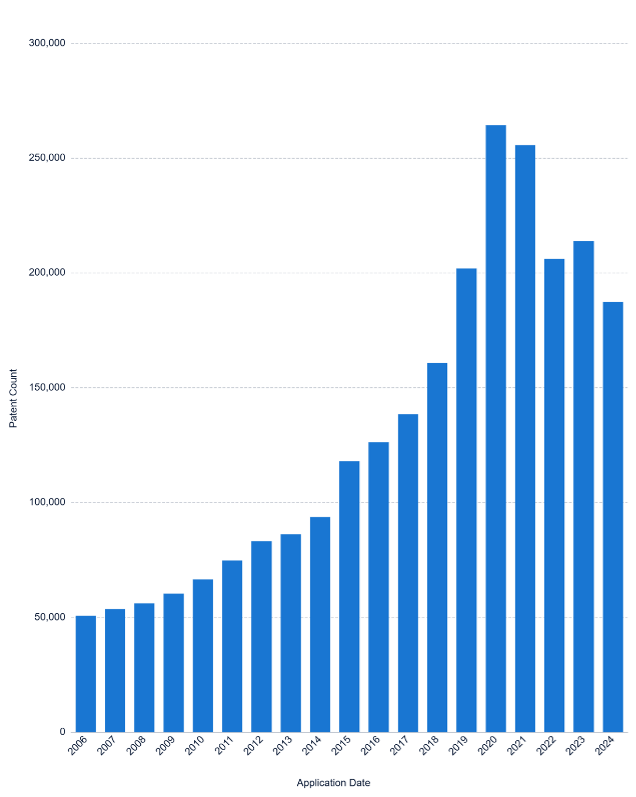
Patents generally cover products and processes that contain new technical aspects and so are applicable to businesses across a wide range of fields. As an example, the figures below illustrate patent applications filed worldwide between 2006 and 2024 in the fields of a) food and beverages, b) medical devices c) cosmetics and d) renewable energy.
a)

b)
c)

d)
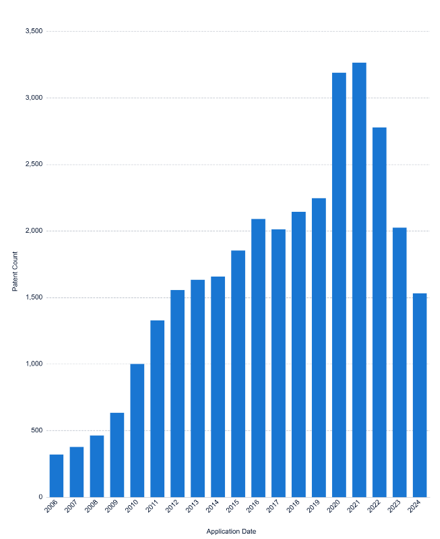
Approximately 2.3 million patent families were filed between 2006 and 2024 relating to food and beverage inventions and 3.6 million relating to all aspects of medical devices. Accordingly, many companies worldwide rely on patents to protect their innovations.
Can I just rely on trade secrets?
Whether you protect your invention using patents or trade secrets is often determined by the nature of the invention itself and the number of competitors in a particular field. Patents require public disclosure, but provide a robust form of protection for up to 20 years for inventions which could be reverse engineered. In contrast, trade secrets provide protection indefinitely, as long as the information remains confidential, but do not provide protection against reverse engineering or independent development of the same invention.
Accordingly, in cases where it may be possible to determine the composition of a product or how a product was formed by simply analysing the product, trade secrets may not be considered a suitable form of protection. A further consideration is the number of competitors which may be looking to develop similar products or are working towards producing solutions to the same challenges as the likelihood of another company independently developing the same or a similar invention will be higher.
What other things do I need to consider?
Confidentiality
Any public disclosure of an invention before the filing of a patent application is highly prejudicial to the chances of obtaining valid patent protection in most jurisdictions. If you do need to discuss your invention with someone other than a patent attorney before a patent application has been filed then you can use a non-disclosure agreement (NDA) to provide some confidentiality, but filing a patent application first is a far better option.
Preliminary Searches
Your invention may not be new, and if so, it is best to find this out quickly. Preliminary searching can be done at an early stage in the development of your invention. In the event a preliminary search indicates that your invention may not be considered novel or inventive in view of earlier disclosures, knowing this at an early stage can prevent you investing in the research and development of a product or process which may not be patentable. However, being aware of such issues at an early stages can allow you to alter the development of your invention in a way which would be considered suitable for patent protection.
Freedom to Operate searches
A patent does not give the owner the right to put the invention into practice as the invention may infringe someone else’s patent. A freedom to operate search can assist you in understanding whether any third parties own a granted patent or pending application which could prevent you from making, using, importing or selling your invention in a particular territory.
How can Mathys & Squire help?
Mathys & Squire has unrivalled expertise in patents, trade marks, design protection and litigation with offices in London, Birmingham, Cambridge, Manchester, Newcastle, Oxford, Luxembourg, Munich and Paris, as well as teams based in China and Japan. Our attorneys (both training and qualified) have a mix of scientific degrees extending from chemistry, biochemistry, pharmacology, genetics, microbiology, plant sciences and zoology through to physics, electronics, telecommunications and engineering. We are passionate about creating and delivering innovative, high-quality, client-focused services and building close and longstanding relationships with clients in order to establish defensive and offensive IP portfolios that generate commercial value.