Until recently, the big question was whether humanoid robots would ever become commercially viable or useful in daily life. Now, as the technology moves closer to real-world deployment, the focus is shifting to who can successfully bring humanoid robots to market at scale.
Intellectual property is vital to gaining a competitive edge, and the race to secure intellectual property rights in humanoid robotics is heating up.
Robots vs humans: who is winning?
For a microcosm of the broader progress in innovation, we can look to the Humanoid Robot Half-Marathon in Beijing, which took place for the first time last year. In 2025, only six of the twenty-one robots competing finished the race, with most of them falling or overheating. And the fastest still took 2 hours 40 minutes, a rather leisurely pace. This year, the winner completed the course in 50 minutes 26 seconds, faster than the men’s half-marathon world record at the time by 6 minutes 54 seconds. Although the competition operated under different rules from conventional human races, the result illustrates rapid progress in humanoid locomotion.
Humanoid robots also appeared on the 2026 season of America’s Got Talent, performing synchronised dance routines alongside human performers. Such developments highlight how humanoid robotics is moving beyond research laboratories and industrial demonstrations into mainstream public awareness.
2026 marks a noticeable turning point. As well as public demonstrations, we are seeing the early commercial deployment of humanoid robotics. Companies are targeting manufacturing, logistics, automotive production and heavy industry. Where robots still fall surprisingly short, however, is in everyday tasks that humans perform without a second thought. According to the 2026 AI Index Report by Stanford University, the best-performing system achieved a success rate of just 12.4% on the BEHAVIOR-1K* benchmark, which evaluates complex household tasks in simulated environments. On a different benchmark, RLBench** , robotic manipulation has achieved a success rate of 89.4% on shorter, more controlled tasks. These results highlight the challenges of developing robots capable of reliably performing complex everyday activities.
Yet, innovation is continuing to challenge what we think robots are capable of. Google DeepMind recently announced Gemini Robotics 2, a robotics foundation model designed to control a wide range of robotic embodiments, including human-like hands. One of the biggest innovation bottlenecks is hands. Human hands contain 27 bones and numerous joints, enabling them to grip objects, turn screws, fold clothes, handle fragile items and use tools. A robotic hand which can achieve the equivalent is extremely difficult to engineer.
The crucial component is AI. Advancements in generative AI and large multimodal models are driving the transformation in humanoid robots, enabling robots to perceive their surroundings, reason about tasks, plan actions and adapt their movements. Using AI, Gemini Robotics 2 can balance a robot’s centre of gravity, so it can step, squat and bend to tackle real-world scenarios, rather than only reaching from a static position.
The race behind the scenes
Alongside the race to build machines able to perform as well as or better than humans, is the race to own the intellectual property behind the technology. It is estimated that global shipments of humanoid robots will exceed 510,000 units by 2030, according to IDC’s latest forecast.
In such a crowded and rapidly growing landscape, it is vital for businesses to seek patent protection for their innovations to maintain a competitive edge. Patent activity is also an indicator of innovation occurring in a field, and patent filings in humanoid robotics have surged dramatically in recent years.
A patent analysis of filings in humanoid robotics
At the end of July 2026, LexisNexis released the results of a patent analysis, covering over 26,000 patent families spanning three technological areas critical to humanoid robotics. These areas are interaction systems, which determine how robots can communicate with humans and their environment; morphology, the design of the robot-body structure and bipedal locomotion; and control and planning architectures. Filings in morphology, which are most indicative of humanoid robots as opposed to other robotics applications, began to rise sharply in 2023.
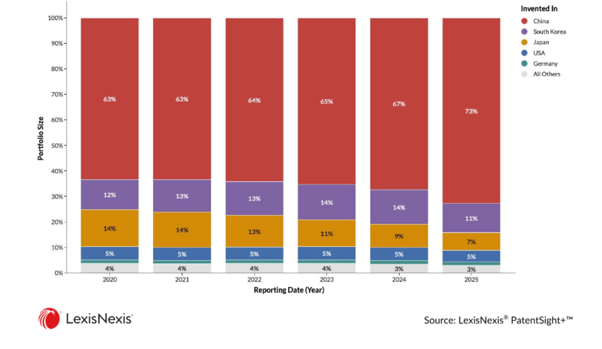
LexisNexis’ analysis shows that China leads in patent activity in these areas. In the last 10 years, patent activity from inventors located in China has doubled in interaction systems, increased 2.5 times in morphology, and 5 times in control and planning architectures. To look at the value of the patent portfolios, LexisNexis collected further information on how relevant the technology a patent protects is to other innovations and the extent of protection considered appropriate by its owner. They aggregated the average patent quality scores of individual patent families and measured them against other patents in the same technological field to assess relative strength. Looking at morphology specifically, China was responsible for 73% of active patent families and 63% of the global portfolio strength by the end of 2025. China is followed by South Korea in size, accounting for 11% of active patent families, Japan at 7% and the United States at 5%. However, across the three technology areas, despite its smaller portfolio, the United States leads in average patent quality according to LexisNexis’ metrics.
What technology can you patent?
Humanoid robots are highly complex machines and an amalgamation of many different patentable technologies. Companies working in this space will need to carefully mine their inventions to identify aspects that may warrant patent protection.
At the fundamental level is the skeleton and structural composition that enable the machine to move like a human. This encompasses components such as actuators, motors, joints, gearboxes and bearings. Companies may file patent applications covering incremental improvements, such as those relating to locomotion, weight reduction and efficiency, rather than only entirely new body structures. Robotic hands, as discussed, present significant engineering challenges, creating opportunities for patent protection around improvements in dexterity and sensitivity.
The robot’s compute and connectivity architecture forms its brain and nervous system, enabling it to process information and make decisions in real time. This requires processors, chips and complex computers, as well as the mechanisms through which different components communicate. As robotics moves from rigid programming to adaptive behaviour powered by AI, AI-driven control systems are becoming increasingly important hotspots for patent protection.
A humanoid also needs to be able to perceive its environment. Modern robots can combine data from cameras and 3D sensors with motion sensors such as inertial measurement units (IMUs), and emerging tactile technologies such as “e-skin.” However, developing a system capable of integrating multiple streams of data in real time is still a significant technical challenge.
Energy and charging technologies present another challenge. Questions surrounding thermal management, energy density, charging speed and battery safety open gaps in innovation. The robot winner of the Beijing Half-Marathon used liquid cooling technology adapted from the smartphones of the company which designed the robot. This is a useful example of how innovations from other technological fields can be adapted to solve specific challenges in humanoid robotics.
Finally, the manufacturing process can also be a source of patentable innovation. Building one robot is difficult, but building 100,000 robots is a different task altogether, and integral to successful commercialisation. Companies may seek protection for technical solutions to problems encountered when scaling production.
Strategic portfolio management
At this critical crossroads in the development of humanoid robots, it has never been more important to consider intellectual property protection. Many different aspects of a humanoid robot may be patentable, but not every innovation will qualify for or justify patent protection. It is important to approach patent filing strategically to build a valuable patent portfolio and not waste resources.
Firstly, an invention must satisfy the relevant patentability requirements, including novelty and inventive step. As the innovation landscape becomes more crowded, new patent applications may face an increasingly complex prior-art landscape. Major innovators span traditional robotics companies, automotive manufacturers and AI-driven startups, creating complex freedom-to-operate considerations for new entrants. Patent landscape analysis can help identify heavily protected technological areas and potential opportunities for innovation, while freedom-to-operate searches can help assess the risk of infringing third-party patent rights. Secondly, companies should consider what patents will be commercially valuable and play a role in their broader business strategy.
Collaboration could also be key to developing complex systems such as humanoid robots. Companies may need to license technologies from others, creating opportunities for intellectual property owners in fields such as chips, sensors and batteries.
The future of humanoid robotics depends in large part on how the intellectual property ecosystem develops. For the companies developing the technologies that make these machines possible, there is an opportunity not only to build the robots of the future, but to own a piece of the technology that powers them.
If you are a company working in the robotics space, our dedicated experts would be happy to help you build and manage your IP portfolio. Our attorneys have in-depth technical knowledge covering hardware, software, sensors, communications, AI and more. Get in touch here.
*BEHAVIOR-1K is a simulation benchmark built around real human needs. The tasks come from surveys asking people what household tasks they want robots to help with, resulting in 1,000 realistic activities. These are long-horizon mobile manipulation challenges in simulated home environments, designed to bridge the gap between current research and human-centred applications.
**RLBench is a benchmark for robotic manipulation that tests agents on a standardized set of 18 tasks using 100 demonstrations per task. Each task involves a different manipulation challenge, such as picking up objects, stacking items, or operating simple mechanisms.