When Brooklyn Beckham published a series of statements on Instagram on 19 January 2026, much of the public’s attention focused on the emotional details of his rift with parents David and Victoria Beckham. But among the allegations of wedding-day tensions, cancelled dresses and family disagreements, one claim in particular caught the attention of trade mark professionals: Brooklyn’s allegation that he was pressured in to “signing away the rights to my name” in the weeks leading up to his wedding.
While the family dispute is still unfolding, the situation offers a timely opportunity to examine how trade mark rights, personal names and commercial control intersect, especially within celebrity families where names are valuable global brands.
Brooklyn alleged that his parents attempted to pressure and “bribe” him into signing over the rights to his name before his wedding – the statements form part of a larger narrative – but regardless of the personal dynamics involved, the idea of “signing away rights to a name” raises important discussions around how celebrity names are protected and monetised.
Under trade mark law, personal names can function as trade marks, and can be inherently distinctive, provided the name is capable of indicating trade origin. The registrability of a sign made up of a famous name depends on both the goods and services applied for and the extent of their fame, as consumers may sometimes view such names as describing the subject matter rather than indicating trade origin – such as in relation to posters and books for example. The names really need to be assessed in relation to the goods and services applied for.
Brooklyn Beckham as a trade mark
Brooklyn’s situation is not unusual in the celebrity world, where personal names frequently evolve into powerful commercial brands. From Victoria and David Beckham to global figures like Beyoncé, Rihanna (Fenty), and Kylie Jenner, many public personalities have turned their names into trade mark‑protected assets underpinning major business ventures. Historic examples such as Disney, Chanel and Ferrari show how a surname can become synonymous with entire industries. Against this backdrop, it becomes easier to understand why control over the name “Brooklyn Beckham” carries both commercial value and strategic importance, and why disputes over such rights can become so sensitive.
The Beckham name is already a globally protected brand, used across fashion, sports, endorsements and commercial ventures. In such families, the name operates not just as an identity but as intellectual property. So if a dispute arises over control, licensing or ownership, trade mark agreements may be involved.
Brooklyn’s allegation suggests pressure to assign rights or enter a licensing arrangement regarding the commercial use of “Brooklyn Beckham” as a brand.
In practice, this could involve:
- Agreeing to not file or use the trade mark “Brooklyn Beckham”
- Signing exclusive licensing agreements
- Giving a third party control over brand management
- Agreeing to restrictions on how he uses his name commercially
These mechanisms are common in celebrity brand management, particularly within families that manage joint portfolios of trade marks. If Brooklyn’s name appears in existing applications or registrations owned by Beckham-related companies, it would not be unusual, but consent and formal agreements are essential.
That said, the UK and EU trade mark registrations for BROOKLYN BECKHAM remain recorded under the name “Victoria Beckham, as parent and guardian of Brooklyn Beckham.” Both registrations are due to expire this year, and it will be interesting to see whether they are renewed, whether fresh applications are filed in Brooklyn Beckham’s own name, or perhaps even whether a new US filing is pursued.
What does this mean for Brooklyn?
Brooklyn Beckham is building his own commercial identity through his food venture: he is the owner of Buster Hot Sauce Inc., the company behind his Cloud23 hot sauce brand, and the business has already secured trade mark registrations in the UK, US and EU. There is even a US application for “Beck’s Buns”. This naturally raises the question of whether the wider Beckham brand would consent to such use, as ‘Becks’ could be considered objectionable, particularly given that David Beckham has long been known by the nickname ‘Becks’ making the mark potentially problematic from both a trade mark and brand protection perspective.
From a brand management perspective, consolidating control helps ensure greater consistency by preventing conflicting or potentially damaging uses of the brand. It also strengthens protection by centralising enforcement under a single rights holder, while supporting a clearer commercial strategy by aligning all brand activities and ventures within the family.
For globally recognised families like the Beckhams, name rights can be worth millions in endorsements and commercial deals. But such control can also create tension where multiple individuals share the same surname yet pursue separate careers, business ventures or personal branding.
Many celebrities do contractually assign elements of their intellectual property, including name rights, to management companies. However, any such assignment must always be voluntary, based on informed consent, and must not interfere with an individual’s fundamental right to use their own name for personal identification.
It is important to note that Brooklyn is not automatically prevented from using his name in trade. UK trade mark law recognises the own‑name defence under Section 11(2)(a) of the Trade Marks Act 1994, which allows individuals to use their personal names provided the use is in accordance with honest commercial practices.
However, the defence has limits. It does not apply to businesses or companies, and it cannot protect dishonest or opportunistic conduct. Crucially, it can also be overridden by contract: if someone has signed an agreement assigning or restricting the commercial use of their name, those contractual terms take precedence. In this context, Brooklyn’s suggestion that he was pressured into signing away rights in his own name is significant, as any such agreement could prevent him from relying on the own‑name defence at all.
Lessons for trade mark strategy
The Beckham situation, regardless of where the truth ultimately lies, illustrates several broader lessons for trade mark strategy, particularly in families or groups that share commercially valuable names.
- First, families managing joint brand portfolios need clear governance structures. Celebrity families often rely on shared trade marks, and it is essential to have transparent agreements setting out who controls what, and for what purpose.
- Second, early discussions can prevent conflict further down the line. When younger family members begin developing their own brands, establishing clear parameters around the use of surnames and personal names can minimise the risk of disputes later.
- Third, trade marks are not purely legal or commercial tools, they can be emotional ones. Control over a name can feel deeply personal, and Brooklyn’s statement highlights how issues surrounding name ownership can carry significant emotional weight in a family context.
- Finally, public disputes can damage the value of a brand. High‑profile conflicts, such as the widely reported Beckham feud, risk diluting the perceived unity and stability of a family brand, potentially impacting public perception and commercial value.
Brooklyn Beckham’s recent public statements have sparked widespread discussion, not only about family dynamics but also about the question of who ultimately controls a name when that name operates as a global brand. His allegation that he was pressured to sign away “the rights to my name” brings into sharp focus the overlap between personal identity and commercial identity in celebrity life.
Regardless of the accuracy of the claims, the situation serves as a clear reminder of the importance of trade mark agreements and brand management, and an appreciation of the fact that names hold both emotional and economic significance. In short, the Beckham dispute is more than tabloid drama, it stands as a case study in modern brand governance, personal rights, and the intersection between family relationships and IP.
We are pleased to share that Partner Nicholas Fox is one of three new General Editors for the next publication of The Chartered Institute of Patent Attorneys (CIPA) Guide to the Patents Act.
The CIPA Guide to the Patents Act, colloquially known as “The Black Book,” is a highly esteemed resource which offers a comprehensive review of the recent developments in patent law. It consists of the full Patents Act of 1977, accompanied by a detailed analysis of its application, drawing on the expertise of over 30 professionals. CIPA has announced that the 10th edition of The Chartered Institute of Patent Attorneys Guide to the Patents Act will be published in 2026.
Nicholas Fox is a qualified solicitor, and a qualified European and Chartered British patent attorney with full rights of audience to appear in IP proceedings at all levels in the English High Court. In addition, he is qualified and admitted as an Attorney-at-Law in the State of New York.
Nicholas is the author of A Guide to the EPC 2000 (CIPA) and has been a contributing author to the CIPA Guide for a number of years, responsible for writing the sections relating to the regulation of the profession. He has lectured on litigation and IP matters for the European Patent Academy and has been a guest lecturer at Queen Mary. Previously, Nicholas was a CPA member of the IPReg Board.
You can keep up to date with CIPA here.
Partner and Head of Trade Marks Claire Breheny has been featured in ‘UK IPO still grappling with surge of trademark filings from front companies’ in MLex.
The article discusses how applications from China played a significant role in another record year for trade mark filings at the UK IPO, many of which are submitted via front companies, which has prompted concern following prior worries in 2023 regarding applications from unregulated representatives.
Claire provided commentary on this jump in trade mark filings, stating that the IPO is struggling to stay on top of them, and shared how the aftermath of filings by unregulated representatives usually unfolds.
Read the article in full here.
We are proud to share that we have successfully passed the ISO 9001 and 14001 audit for the 9th year.
The British Assessment Bureau leads the ISO certifications to evaluate businesses on their commitment to excellence in work processes and management systems.
ISO 9001 (Quality Assurance) showcases the firm’s dedication to delivering an excellent standard of customer service which is both consistent and constantly improving, and signifies that we meet the globally recognised benchmark.
ISO 14001 (Environmental Management) demonstrates the firm’s adherence to environmental guidelines, recognising the care we take to use resources in an efficient way and reduce waste. This certification clearly shows the meaningful progress we are making in reducing our carbon footprint.
We are proud of our environmental awareness as a firm, and are delighted to be able to formalise our progress and gain recognition for our dedication to providing a first-class service to our clients.
To find out more about ISO 9001 and ISO 14001, click here.
As of the 1st of January 2026, regulations in Chinese intellectual property law are shifting to impact the measure of patentability for AI-related inventions.
Key takeaways
- China has introduced stricter examination standards for AI-related patent applications, with a strong emphasis on legal compliance, ethics, inventive step and sufficiency of disclosure.
- AI inventions involving unlawful data use, algorithmic discrimination or violations of public interest will not be patentable.
- Merely applying existing AI models to new scenarios without substantive technical modification is unlikely to satisfy the inventive step requirement.
- Applicants are expected to provide more detailed technical disclosure of AI models, training processes and data relationships.
Background
On 10 November 2025, the China National Intellectual Property Administration (CNIPA) issued Order No. 84 amending the guidelines for patent examination, with effect from the 1st of January 2026. The amendments follow a public consultation process and build upon the Guidelines for Patent Applications Related to Artificial Intelligence (Trial) issued in December 2024.
AI is a major focus of the amendments, reflecting both rapid technological development and increasing regulatory attention to ethical and governance concerns.
Key changes affecting AI-related patent applications
Ethical and legal compliance as a patentability requirement
CNIPA has explicitly introduced examination standards under Article 5(1) of the Patent Law, pursuant to which inventions that violate laws, social morality or public interests are excluded from patent protection.
In practice, this means that AI inventions involving:
- unlawful collection or use of personal data (e.g. facial recognition without consent); or
- algorithmic decision-making based on discriminatory criteria (such as gender or age),
may be refused on public policy and ethics grounds, regardless of their technical merits.
Inventive step: substance over application scenario
The amended Guidelines clarify that:
- changing only the application scenario or target object of an existing AI algorithm or model, without substantive technical modification, will generally be insufficient to establish an inventive step; whereas
- meaningful changes to model structure, parameters, training methods or technical effects, even within a similar application field, may establish an inventive step.
This reinforces CNIPA’s expectation of a genuine technical contribution, rather than a repackaging of known AI techniques.
Higher disclosure threshold for AI inventions
Applicants must now pay closer attention to sufficiency of disclosure, particularly where AI models exhibit “black box” characteristics.
Specifications should generally disclose:
- model architecture (modules, layers and connections);
- training steps and key parameters; and
- the technical relationship between input and output data, especially where AI is applied to specific industrial or medical scenarios.
Refinement of the examination object for AI and big data-related applications
The first sentence of Section 6.1 “Examination Principles” has been amended from:
“Examination shall be conducted with respect to the solution for which protection is sought, namely the solution defined in the claims,”
to:
“Examination shall be conducted with respect to the solution for which protection is sought, namely the solution defined in the claims, and, where necessary, with respect to the contents of the description.”
This amendment enables a more comprehensive and thorough examination of AI- and big data–related patent applications.
Practical implications for applicants
- Early compliance review: assess data sources, training logic and decision rules for legal and ethical risks.
- Drafting strategy: emphasise technical improvements to AI models, not merely new application contexts.
- Disclosure discipline: balance protection scope with sufficient technical detail to meet CNIPA standards.
At Mathys & Squire, we have patent attorneys who specialise in AI and the patentability of AI-related inventions, as well as patent attorneys with experience filing patents in China. Please get in touch with a member of our team here if you are seeking advice.
AI is becoming more and more rooted in everyday life, making tedious tasks easier and more efficient. However, using AI for tasks which require rigorous diligence and involve confidential information, such as patent drafting, could be fatal. SMEs and inventors must carefully consider when AI is appropriate and when it will cause more harm than good.
The Chartered Institute of Patent Attorneys (CIPA) recently published their guidance on using AI tools as an SME or inventor. The guidance stresses the importance of being aware of the risks which come with using AI in patent work. AI undermines two core pillars of the patent system: human invention and absolute confidentiality. AI errors in a poorly drafted application could cause problems for years to come, whilst the unintended disclosure of information, such as inputting your invention into non-confidential AI tools, could render your patent application wholly unviable.
The risks
CIPA underlines several key risks behind using AI tools for patent work:
- Confidentiality breaches: Once you input material into AI, you cannot guarantee what will happen to it. The information may be treated as disclosed to the public, meaning the invention can no longer be patented and trade secrets become public domain.
- Hidden inaccuracies: Errors produced by AI may not be easy to notice but could emerge during enforcement or litigation later down the line.
- Patentability failures: There are very strict requirements for patent applications which determine whether an invention meets the patentability criteria. For example, “sufficiency of disclosure” requires that the invention is described completely, allowing other skilled people to replicate it. AI may not describe an invention to the necessary extent.
- Human inventorship requirements: The named inventor(s) of a patent must be human. Depending too heavily on AI can overshadow human contributions.
- Data training risks: AI tools may use your input material as training data for future AI models which could benefit competitors.
What to do
It is vital to never input a description of an invention into AI tools before you have filed a patent application. AI tools with guaranteed data isolation and which promise confidentiality can be considered, but care should still be taken to thoroughly check the accuracy of the output and provide clear evidence of human contribution. You can monitor evolving AI regulations through ongoing guidance from the Chartered Institute of Patent Attorneys and the UK Intellectual Property Office.
It is recommended to seek counsel from a patent attorney who has knowledge of the technology and legal landscape, and can advise you on your use of AI. Patent attorneys are also vital sources of information regarding what constitutes a complete and viable patent application, and will be more attuned to AI errors.
At Mathys & Squire, we have patent attorneys who specialise in AI and have a deep understanding of the legal implications for both AI-based inventions and the use of AI tools. Please get in touch with a member of our team here if you are seeking advice.
To read the full guidance from CIPA click here.
Partner Andrea McShane has been featured in the World Intellectual Property Review, the Daily Express, London Loves Business and Business Money following her commentary on the UK’s ‘Patent Box’ scheme which provides tax breaks on inventions which are patented, encouraging businesses to keep and commercialise intellectual property.
Andrea McShane argues that it should be more simple for SMEs to take part in the patent scheme, as high compliance costs and complex requirements for claims prevent them from reaping the benefits.
Read the extended press release below.
SMEs received only 5% or £100m of the £2bn in tax breaks claimed last year that are intended to encourage businesses to file more patents, says intellectual property (IP) law firm Mathys & Squire [Source: HMRC].
The UK’s patent box tax relief can save companies tens of millions of pounds by reducing corporation tax on profits from patented inventions to 10%, down from the standard 25%. It was introduced to encourage business to invest in R&D and then patent their inventions and bring them to market.
SMEs are estimated to generate 52% of the turnover of all UK businesses [Source: Department for Business and Trade].
Mathys & Squire says SMEs face higher barriers to claiming the tax break because of high compliance costs and uncertainty over whether their claims will be approved by HMRC. This can even deter them from investing in R&D in the first place.
Andrea McShane, Partner at Mathys & Squire, says: “Patent box can save businesses very significant amounts of corporation tax but in our experience only few smaller companies pursue this tax break. For many SMEs the costs and uncertainties of getting into the patent box regime simply outweigh the benefits.”
“Some SMEs develop genuinely exciting inventions but give up on protecting them, potentially making it easy for competitors to imitate them, but also losing out on their patent box opportunity.”
McShane says patent box claims can be very complex, making it disproportionately costly for SMEs to pursue them.
“Patent box claims can be challenging to prepare, which puts smaller businesses at a clear disadvantage compared to larger ones,” she says.
“Larger companies can afford more extensive protection of their IP, more sophisticated tax advice and accountancy tools to set up systems to track income relating to relevant patent rights. Small businesses working on tight budgets may not be able to afford that.”
McShane says the government must do more to help smaller companies benefit from the relief if it wants to improve the UK’s low level of R&D spend. Currently, spending on R&D in the UK is estimated to be 2.9% of GDP [Source: World Bank], behind countries such as the US (3.6%), Japan (3.4%) and Germany (3.1%).
McShane says this could be achieved by removing requirements on SMEs specifically. It can also be more generous, for example through subsidies. SMEs could for example receive help in covering the costs of patenting inventions so smaller innovators are not discouraged by the expense of developing and protecting inventions.
The UK Intellectual Property Office (UKIPO) has announced proposed fee increases averaging 25% across trade marks, patents, and designs, subject to parliamentary approval. These changes would represent the first adjustment for design fees since 2016, for patent fees since 2018, and the first increase for trade mark fees in nearly 30 years.
According to the UKIPO, the revised fee structure is intended to reflect the 32% rise in inflation since 2016 and to manage future cost pressures that cannot be fully mitigated through efficiency measures or the use of reserves. The additional revenue is expected to support continued investment in digital infrastructure and service quality, while ensuring the UKIPO remains among the most competitively priced intellectual property offices globally.
The proposed average increases are:
- Patents: 33%
- Designs: 24%
- Trade marks: 23%
Full guidance is expected to be published in early 2026 to assist rights holders and applicants whose fees may fall due around the implementation period. Current fees will remain in place until 1 April 2026, when the new fee structure is scheduled to take effect, subject to parliamentary approval.
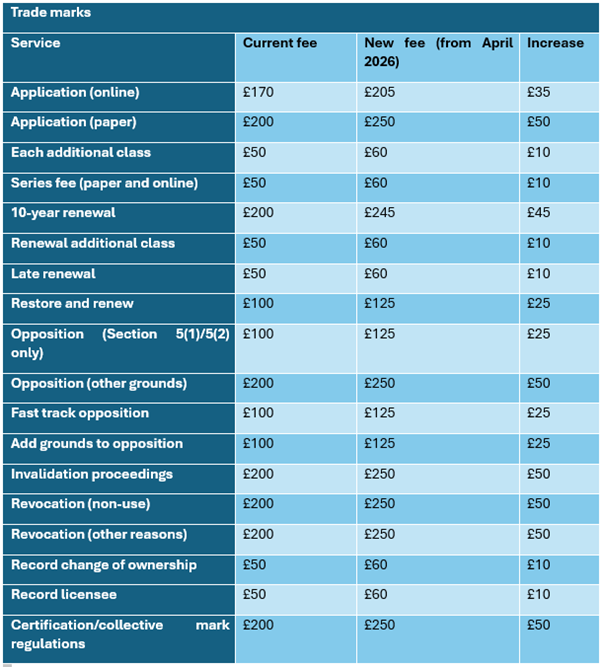
Trade Mark Fee Increase:
Trade mark application fees will rise under the new structure, with the fee for filing a trade mark application online increasing from £170 to £205, whilst paper applications will rise from £200 to £250.
Renewal fees will see also increases across the board – the fee for renewing a trade mark registration will rise from £200 to £245 for both online and paper applications.
Series trade mark applications are also set to increase from £50 to £60. While earlier reports suggested that series applications may be abolished, the proposed fee increase indicates that they are likely to remain in place, at least for the time being. This means applicants wishing to file a series of trade marks will still be able to do so, albeit at a higher cost, reflecting the broader trend of rising UKIPO fees across all trade mark services and we recommend filing sooner rather than later to take advantage of current rates and to account for the potential future phasing out.
Opposition proceedings will become more expensive, potentially leading to more selective or strategic use of opposition proceedings. The fee for filing a notice of opposition based solely on Section 5(1) or 5(2) grounds will increase from £100 to £125, whilst oppositions on other grounds will rise from £200 to £250. Fast track opposition fees will increase from £100 to £125, and the fee for adding grounds to an opposition will rise from £100 to £125.
Applications to start invalidation proceedings will increase from £200 to £250, whilst applications to revoke a mark for non-use or other reasons will also rise from £200 to £250.
The increases in opposition, invalidation, and revocation fees mean that parties seeking to challenge a trade mark, or defend against a challenge, will face higher upfront costs.
The table below outlines the current fees alongside the proposed increases:
Designs Fee Increase:
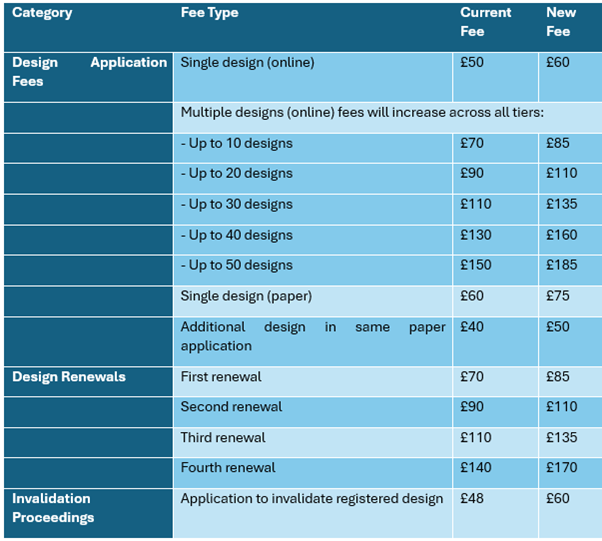
The upcoming increase in UKIPO fees for registered designs will have a range of implications: higher filing and renewal costs will raise the overall expense of maintaining design portfolios, particularly for businesses with multiple registrations. Companies may respond by filing fewer variations, allowing lower-value designs to lapse. Smaller designers are likely to feel the impact most, potentially relying more on unregistered rights despite their weaker protection. While the change could reduce speculative filings and ease administrative burdens, smaller businesses may adjust their approach to registered protection, which could influence innovation patterns across certain sectors. Rights holders should consider filing or renewing designs (if able to) before the fee increase takes effect, reassess the value of their portfolios, and adjust budgets and IP strategies accordingly.
Patent Fee Increase:
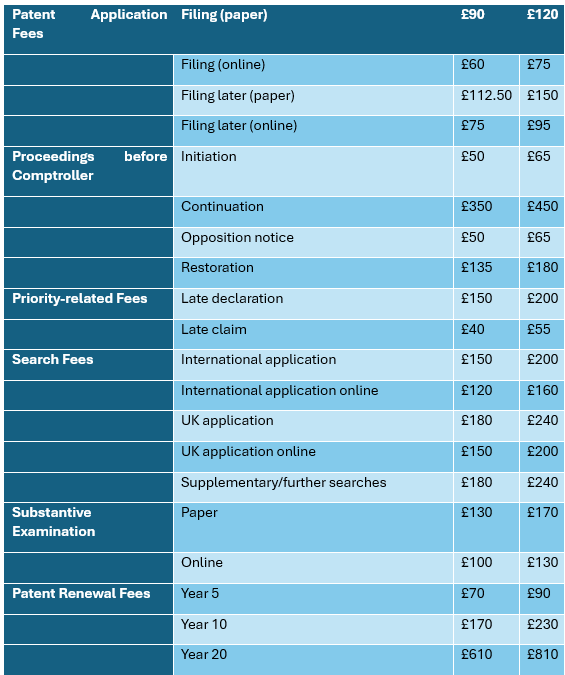
The UKIPO is also set to update the patent fee schedule, with all major fees for patent proceedings set to increase. Notably, the total basic fees for filing a UK patent application, including filing, search, and examination, will rise from £310 to £405. In addition, the revised patent renewal fees will range from £90 to £810, depending on the stage the patent lifecycle.
What this means going forward:
Although UKIPO fees will remain at current rates until 31 March 2026, the proposed average increase of around 25% is likely to affect budgeting and the timing of IP activities. Specifically:
- IP Filing strategy: Consider bringing forward planned applications, searches, and filings to take advantage of current fees before the increase. Early awareness allows you to act proactively and protect your brand while avoiding higher costs. We can help assess the impact on your portfolio and provide tailored fee estimates and timeline options.
- Portfolio management: Review the timing of renewals, recordals, oppositions, and cancellation actions that incur IPO fees to determine whether it makes sense to schedule them before 31 March 2026. Businesses that regularly file trade marks, designs or patents should budget for the potential fee rise. The renewal period opens six months before the renewal deadline for trade marks and designs, and three months in advance for patents.
- Decision making/budgeting: This may affect the decision-making process for both potential opponents and respondents, particularly for smaller businesses or individual applicants as they may need to evaluate the merits of a dispute more carefully before proceeding, particularly in cases where the likelihood of success is uncertain. This could alter the overall landscape of IP related disputes in the UK in regard to filing oppositions and invalidity and/or revocation actions. The same is also true for heavy filers and/or oppositions. Internal budgets for the following year will already have (or will soon have) been set and therefore whilst the increases are not necessarily problematic per se, given the number of filings/renewals/oppositions they may file could mean substantial overall increases. Heavy filers/larger businesses will need to factor higher fees into trade mark enforcement and defence budgets, prioritising key cases or exploring cost-effective strategies where necessary.
The UK IPO has updated its payment guide and deposit account terms. You can view the payment guide here and the updated terms here.
If you have upcoming filings or renewals, now is an ideal time to review timelines and budgets and discuss your IP strategy with your patent or trade mark attorney. Our team at Mathys & Squire are committed to delivering exceptional client support and tailoring services to your specific needs. For any questions regarding the UKIPO’s fee increase or assistance with future IP planning, please contact us.
The UK Intellectual Property Office (UKIPO) has proposed fee increases, averaging around 25%, across trade marks, designs and patents, with changes expected to take effect on 1 April 2026, subject to parliamentary approval. These will be the first major adjustments in several years, reflecting rising inflation and supporting UKIPO investment in digital systems and service quality.
However, the new UKIPO fees will still be relatively inexpensive compared to other jurisdictions, maintaining the UK as an attractive territory for securing IP protection.
Patents
All major fees for patent proceedings before the UKIPO will also rise. In particular, the total basic fees for filing a UK patent application (filing, search and examination) will rise from £310 to £405, and the new patent renewal fees will be in the range £90–£810.
Trade Marks
Application and renewal costs will rise, with online filing increasing from £170 to £205 and renewals from £200 to £245. Opposition, invalidation and revocation fees will also increase, potentially prompting more selective enforcement action. Series applications, now rising from £50 to £60, will remain available for the time being.
Designs
Design application and renewal fees will increase across all tiers, affecting businesses with large portfolios. Higher costs may prompt applicants to streamline filings or reassess the value of older registrations. Invalidation actions will also become more expensive.
What Businesses Should Do
Although current fees apply until 31 March 2026, the scheduled increases mean applicants may wish to begin reviewing their IP strategies to:
- Plan budgets early, especially for businesses with high filing volumes.
- Bring filings and renewals forward where possible to secure lower fees.
- Audit portfolios to manage renewals cost-effectively.
- Reassess dispute strategy, as higher opposition and invalidation fees may influence when to challenge third-party rights.
Full guidance from the UKIPO is expected in early 2026. A link to a more detailed article with the full fee increases and implications is provided here.
Gene therapy is revolutionising the field of molecular medicine and the capabilities of therapeutic approaches. Recent developments demonstrate the potential for gene therapy to address some of mankind’s most devastating diseases, unlocking previously unfathomable solutions which could transform people’s lives. As innovation accelerates, strong patent protection is essential to navigate rising IP disputes and safeguard gene therapy advances.
Introduction to gene therapy
Gene therapy is a medical technology which mitigates or eradicates the symptoms of diseases by transferring genetic material to a patient or correcting genetic defects. It can be achieved in several ways.
- Gene replacement delivers a functional copy of a gene to compensate for a defective one, making it especially useful for recessive monogenic diseases.
- Gene silencing reduces the expression of harmful genes, often through RNA interference or CRISPR–Cas13 targeting of pathogenic mRNA.
- Gene editing directly modifies endogenous DNA using tools like CRISPR-Cas9, zinc-finger nucleases, TALENs, or newer base and prime editors. These technologies allow targeted correction or disruption of disease-causing genes with increasing precision.
The genetic material can be delivered to the patient via viral and non-viral systems. For example, viral vectors such as adeno-associated virus (AAV) are preferable for in vivo use due to their safety and tissue specificity. Non-viral systems (such as lipid nanoparticles and polymer-based carriers) usually offer improved safety and flexibility but typically lower delivery efficiency.
Today, gene therapy is applied to an increasingly wide set of diseases. An analysis of patent activity shows that oncology accounts for roughly 32% of the gene therapy market, followed by rare genetic disorders (27%), cardiovascular diseases (15%), and neurological disorders (12%).
Recent innovation in the field
Whilst gene therapy is still predominantly limited to research and clinical trials, with over 250 clinical trials running in Europe and only around 20 therapies on the market, broader clinical adoption is getting closer.
The UK’s Medicine and Healthcare products Regulatory Agency (MHRA) approved the world’s first CRISPR-gene therapy in November 2023 and it is now available on the NHS in England. Named CASGEVY®, the drug (exagamglogene autotemcel) uses CRISPR-Cas9 to alter human stem cells to produce functional rather than defective haemoglobin, treating sickle cell disease and beta thalassemia.
Other advances are also setting the field into motion, such as innovations in delivery methods. Among these, AAVs are emerging as a major force in the gene therapy market. In June this year, Barcelona-based startup, SpliceBio, secured €118 million in a series B finance round to fund their development of AAVs with refined capabilities, able to carry longer genes.
The rapid rise of AI in biomedical research is also transforming how scientists design and test new therapies, including in gene editing. Stanford Medicine researchers have introduced CRISPR-GPT, an AI “copilot” that draws on extensive scientific literature and lab records to propose experimental designs, predict off-target risks, and justify its recommendations.
The patent wars
There are currently over 14,000 patent families related to gene therapy worldwide. Early patents mainly targeted basic delivery mechanisms and methodological approaches, but the focus has grown more specific over time, covering specific disease indications, vector designs and genetic modification techniques.
CRISPR-Cas9 in particular has been the topic of a major dispute over the last decade and the contest for the foundational patent rights is still ongoing. CRISPR-Cas9 was introduced as a programmable gene-editing tool in 2012 by Jennifer Doudna and Emmanuelle Charpentier, a discovery that later earned them the 2020 Nobel Prize in Chemistry. Around the same time, Feng Zhang and the Broad Institute demonstrated its use in mammalian cells, triggering a long-running patent battle. This leads to uncertainty and legal risks which impede those who wish to use CRISPR.
CVC
In Europe, one of the two leading CRISPR patent portfolios is held by the team behind the Nobel-winning discovery, collectively known as “CVC” (the University of California, the University of Vienna and Emmanuelle Charpentier). Their core rights are based on the fundamental patent family originating from parent application EP2800811, along with a series of divisional filings. The patents EP2800811 and EP3401400 (one of the divisional applications in the family) were originally maintained by the EPO Opposition Division, but these decisions were appealed. In its preliminary opinions, the Board of Appeal found that neither patent could rely on the earliest priority date because the earliest priority document failed to disclose the essential PAM sequence required by the CRISPR-Cas9 technology, rendering the claims not novel over the Science publication from the same inventors.
CVC decided to withdraw their approval of the granted texts in 2024, effectively revoking both patents to possibly avoid an adverse final decision that could negatively affect their broader CRISPR portfolio (see our relevant article here). The patent family still includes other active members including EP3597749, EP4289948 and EP4570908, with EP3597749 and EP4289948 already facing opposition. We can expect further disputes as the CRISPR patent landscape continues to evolve.
The Broad Institute
On the other hand, the Broad Institute (together with the Massachusetts Institute of Technology and Harvard College as co-applicants) also obtained early patent rights in Europe based on the patent family originating from parent application EP2771468. The patent was revoked in 2020 on the basis of intervening art that only became citeable due to invalid priority (in which one of the opponents was represented by Mathys & Squire). In this regard, the Board of Appeal held that a priority claim was deemed invalid if a proprietor was unable to show, when challenged, that the applicants for the subsequent application included all of the applicants for the priority application or their successor(s) in title at the time the subsequent application was filed (see our earlier articles here and here).
Interestingly, the recent decision G1/22 issued by the Enlarged Board of Appeal has significantly relaxed the EPO’s approach to “same applicant” priority. The EBA decided that there is a “rebuttable presumption” that the priority applicants approve of the subsequent applicants’ entitlement to priority, regardless of any difference in names (see our earlier article here). The divisional patents EP2784162 and EP2896697, and the relevant patent EP2764103 were originally revoked by the Opposition Division under similar reasons as with EP2771468, but the Board of Appeal have decided to return these cases back to the Opposition Division as the priority entitlement is now considered valid. Opposition proceedings are ongoing, and it will be interesting to see how these cases ultimately unfold.
Recent developments
Other companies have also been entering the legal battlefield in recent years. ToolGen, for example, filed an infringement suit against Vertex’s CASGEVY® therapy in April 2025 in the UK. The ongoing wave of disputes illustrates that the CRISPR and gene therapy patent landscape remains highly competitive. Thus, securing robust patent protection is crucial for companies seeking to commercialise their technologies.
How to protect innovation in gene therapy
Protecting gene therapy technology in Europe requires an early, well-structured patent strategy.
The foundation of any successful patent strategy is a comprehensive freedom-to-operate (FTO) analysis, which should be conducted as early as reasonably possible in the development pipeline. FTO searching allows innovators to identify third-party patents that may block research or manufacture of a gene therapy product. This is especially important in fields such as CRISPR-Cas systems, where multiple parties hold overlapping rights. An FTO review not only helps avoid infringement but can also inform strategic design-arounds, licensing decisions, and the scope of future patent filings.
Equally critical is the issue of valid priority filing, an area that has been at the centre of some of the most high-profile European disputes in gene editing as discussed above. The EPO is well known to be very strict on added matter, and it extends to the assessment of priority validity. The priority filing should include all essential features of the invention and the way for performing the invention that are later claimed. Omissions can result in the loss of the earliest filing date and, consequently, exposure to intervening prior art. Although the recent decision G 1/22 appears to have relaxed the “same applicant” priority rule in Europe, the underlying requirement of adequate technical disclosure remains stringent and fundamental.
Patent drafting
When drafting the patent application itself, a successful strategy typically involves pursuing multiple categories of claims. For gene therapy inventions, this may include:
- Composition of matter claims for the drug product, which might include specific nucleic acid, Cas enzymes, engineered cells, viral vectors, lipid nanoparticles or other delivery vehicles
- Sequence-specific claims for novel nucleic acid sequences
- Medical use claims for using the gene therapy product as a medicament or to treat specific diseases.
- Formulation claims for the specific solutions, buffers or excipients used to stabilise and deliver gene therapy components
- Dosage regimen and administration-route claims for optimised therapeutic windows and dosing approaches
- Manufacturing and process claims for nucleic acid production, cell-expansion protocols, vector-production methods, or purification steps involved in the production of the gene therapy product.
In view of the complexity of gene therapy patents, it is important to seek professional support. The application must be drafted effectively to secure appropriate breadth of protection, while also facilitating a smoother path to grant.
SPCs
Finally, as products approach regulatory approval, innovators might also consider Supplementary Protection Certificates (SPCs). SPCs extend protection for medicinal products beyond the standard 20-year patent term. This compensates for the time lost during regulatory review. Gene therapy products authorised in the EU may be eligible for SPC protection, provided they meet the regulatory and patent linkage criteria. Our professional team can guide applicants through SPC strategy and the application process (see here for further information).
Gene therapy is advancing rapidly, but its patent landscape remains complex and highly competitive. Careful strategy including strong priority filings, thoughtful claim drafting and early FTO analysis is essential. Robust IP protection allows innovators to focus on advancing therapies rather than defending their inventions.