“Provisional” vs “non-provisional” and “priority”: What do they mean in the UK?
2026

10 mins
“Provisional” and “non-provisional” are terms which often come up in conversation with startups, but how are they relevant to your UK and European filing strategy?
Written by: Oliver Jones and Andrew White
Working with early-stage inventors, SMEs and startups, we are regularly asked about “provisional” and “non-provisional” filings in the UK and abroad, namely what they are and how they can be used in order to protect a business’s IP.
But what does “provisional” and “non-provisional” mean? And more specifically, how is this relevant to your UK or European applications, and overall filing strategy?
In brief, provisional and non-provisional applications are a uniquely American concept, and the UKIPO and EPO don’t make a distinction between the two. In this article, we shall aim to demystify these terms and explain how, in many ways, a UKIPO filing is often superior to filing a separate provisional application first. Firstly, in order to explain what a provisional application is and what it is for, it is helpful to explain the concept of “priority”.
What is “priority”?
Patents, like many IP rights, are jurisdiction-specific. If you have a UK patent, it can only be infringed by competitors performing infringing acts in the UK. Similarly, if you have a US patent, it can only be infringed by acts in the US and so forth. Therefore, if you plan to expand your business to multiple jurisdictions, it is often not enough to have IP protection in only one jurisdiction. However, filing all of your applications in every jurisdiction simultaneously is a costly business. Helpfully, there is a legal mechanism known as a right of priority which allows applicants to file in multiple jurisdictions in a phased manner. By using this priority right, a lot of upfront costs can be deferred.
The right of priority means that, should an applicant file their first patent application to a given invention in one jurisdiction (e.g. UK or Europe) , that applicant has 12 months to file further applications to the same invention in other jurisdictions and claim priority to that first application. As a result, even though those applications are filed later, for the purposes of determining what public disclosures are citable, the later applications are considered to have the filing date of the first application.
This provides businesses with a significant amount of flexibility in their filing strategy, as applicants can file a first application in a single jurisdiction to secure a filing date. Then applicants have an entire year to talk to investors, manufacturers, distributors etc. to determine the market viability of a product, before filing in other jurisdictions without the risk of invalidating their later-filed applications. This provides applicants, particularly small businesses and startups, with the time to secure funding before incurring the (often significant) costs of filing in multiple jurisdictions.
So how does a provisional application fall into this?
Provisional applications
Provisional applications are unique to the patent system of the US. There is no equivalent in other jurisdictions, such as the UK and EPO. Like any other application, an applicant can claim priority back to the provisional application, including with a non-provisional patent application filed at the USPTO.
However, unlike other applications, such as non-provisional applications (sometimes referred to as a utility patent application) in the US or patent applications of other jurisdictions, a provisional application never grants and is not searched or examined. The purpose of a provisional application is solely for securing a filing date for an invention from which to claim priority.
A non-provisional application in the US is the equivalent of an application filed at the UKIPO or EPO in that it is searched, examined, and will hopefully lead to a granted patent.
As a result of this separation of concerns, a particular strategy that is common in the US is filing a short provisional application, which briefly describes the invention in order to secure a filing date, and then 12 months later fleshing out the details with specific implementations and potentially any new features that have been developed for a non-provisional application.
This strategy typically works if you are only interested in US protection for several reasons. In particular, unlike the UK and Europe, the US has a grace period for the inventor’s own disclosures, so the inventor’s activity in the intervening year is less relevant. In addition, the US tends to have a more generous assessment of priority than other jurisdictions.
However, these differences between the first and subsequent filings can cause issues for the validity of the priority claim in other jurisdictions such as the UK and Europe. This isn’t an issue that is specific only to provisional applications, per se, but the way that provisional and non-provisional applications are distinguished makes the issue more common when relying on a provisional and subsequent non-provisional application.
In addition, because a provisional application is not searched or examined, it does not provide applicants with any further information to guide their IP strategy in the intervening 12 months.
Let us take a look at each of these issues in turn.
The same invention
Each jurisdiction typically implements Articles 4A and 4B of the Paris Convention in its own legislation. In particular, the European Patent Convention recites how an applicant may have a priority right “in respect of the same invention.”
Similar language is also present in the UK Patents Act 1977, which instead requires “an invention to which the application in suit relates [be] supported by the matter disclosed in the earlier relevant application or applications”.
If the later application is not directed towards the same invention as the earlier application, then the claim to priority is invalid, and any disclosure within the intervening 12 months still counts as prior art against the later application. This is a very real risk where a provisional application is brief and is then fleshed out 12 months later in the non-provisional application.
Let us demonstrate with an example:
- A start-up files an initial application to invention A on 1st January 2026. For example, a UKIPO application, EPO application, or a provisional application.
- 12 months later, they file a more detailed application to invention A combined with feature B on 1st January 2027 (e.g. a further UKIPO or EPO application, or a non-provisional application in the US) claiming priority to the initial application. For example, over the intervening 12 months, the start-up may discover that invention A only works when it is used in conjunction with feature B. Alternatively, feature B may simply be a more specific implementation that the start-up is looking to commercialise that was not otherwise included in the original application.
While both applications describe invention A, feature B may be considered not to be “in respect of the same invention” by the EPO and UKIPO. As a result, the combination of A and B may not be entitled to the 2026 priority date. This could be catastrophic if the product with feature B has been disclosed to investors or gone to market in the intervening year, as it may render the entire application invalid.
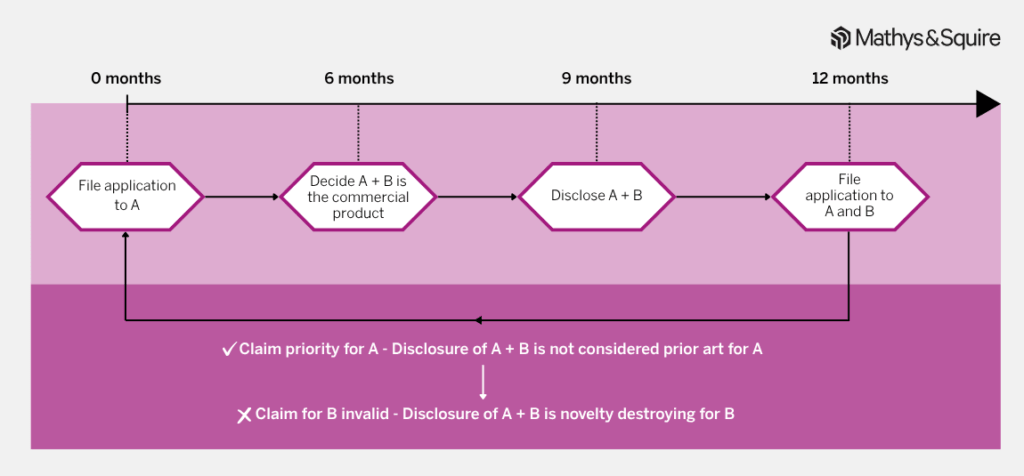
None of this is to say that new developments and features cannot be included in later filings; such developments are a common occurrence in fast-moving markets. However, when considering your patent strategy, it is always important to include as much information and detail in the initial application as possible in order to minimise these risks.
Planning international strategy
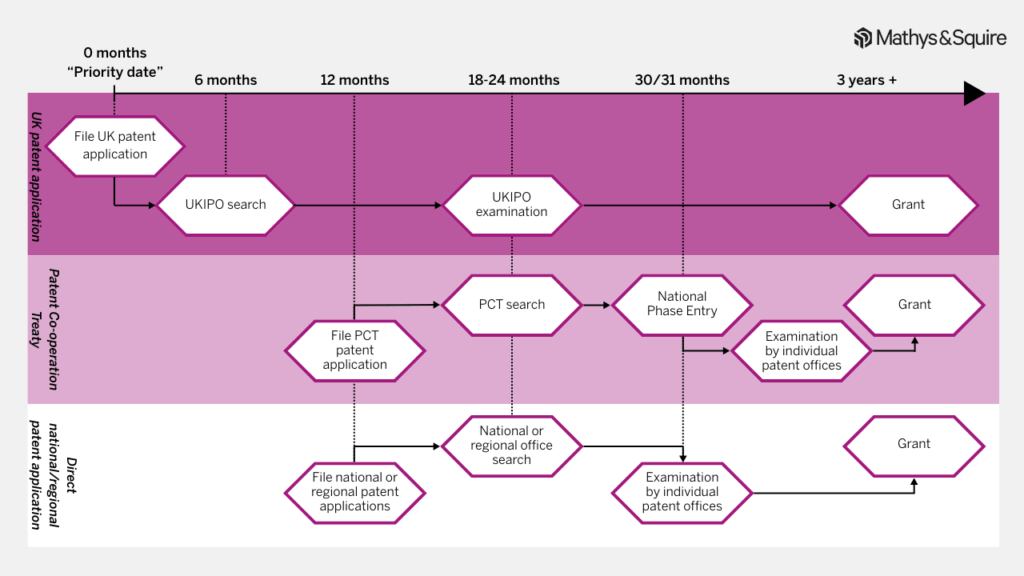
As mentioned above, one of the benefits of the priority period is that it allows applicants to avoid having to file all their applications everywhere at once. Instead, they can defer most of these costs by 12 months. However, international filings can still be expensive (e.g. £2000-£4500 per jurisdiction at the 12 month deadline), particularly since many countries require a local professional representative to file on your behalf, not to mention further costs for responding to office actions, and subsequent grant and renewal fees.
Without having your invention searched before this 12-month priority deadline, there is a very real risk of filing all these applications after 12 months and receiving objections that may be very difficult to amend. Unfortunately, since a provisional application is not searched or examined, a provisional filing cannot mitigate these risks alone.
In contrast, the UKIPO can provide a high-quality search, typically within 6 months, for a comparable fee (£405 for search and examination at the UKIPO vs $65-$260 for a provisional application at the USPTO). This search can then give applicants plenty of time to review, assess and plan an international strategy without a significant up-front cost.
Furthermore, if budget is a concern, UKIPO fees do not need to be paid on filing, and an applicant still receives a filing date from which to claim priority. As a result, an application filed at the UKIPO without paying fees can serve the same function as a US provisional application, which has mandatory fees.
Key takeaways
- The distinction between provisional and non-provisional applications is unique to the US patent system. The UKIPO and EPO do not have provisional applications.
- In the UK and Europe, it is generally advisable to prepare a full patent application up front, especially if multiple jurisdictions are of interest.
- Filing an application at the UKIPO without paying fees is functionally similar to a US provisional application.
- Getting a search on your first application can provide an essential steer from which to base international filing strategies 12 months later.