Emotional Perception and First Filing Strategies
2026

10 mins
On the 11th of February, the UK Supreme Court announced their decision in the case of ‘Emotional Perception AI Ltd (Appellant) v Comptroller General of Patents, Designs and Trade Marks (Respondent).’
Written by: Oliver Jones
The long-anticipated Supreme Court judgement in the case of Emotional Perception AI vs Comptroller General of Patents has a sweeping impact on not just the way AI inventions are assessed at the UKIPO, but also how any ‘mixed-type’ invention (i.e. inventions that include a mixture of technical and non-technical features) should be considered.
In particular, the judgment overturns the 20-year precedent of the Aerotel test which, until recently, was the primary method of assessing mix-type inventions such as those involving AI. In some instances, this would lead to objections before an application had been searched on the grounds that the invention is directed to something not eligible for patent protection.
What does this ruling mean for businesses?
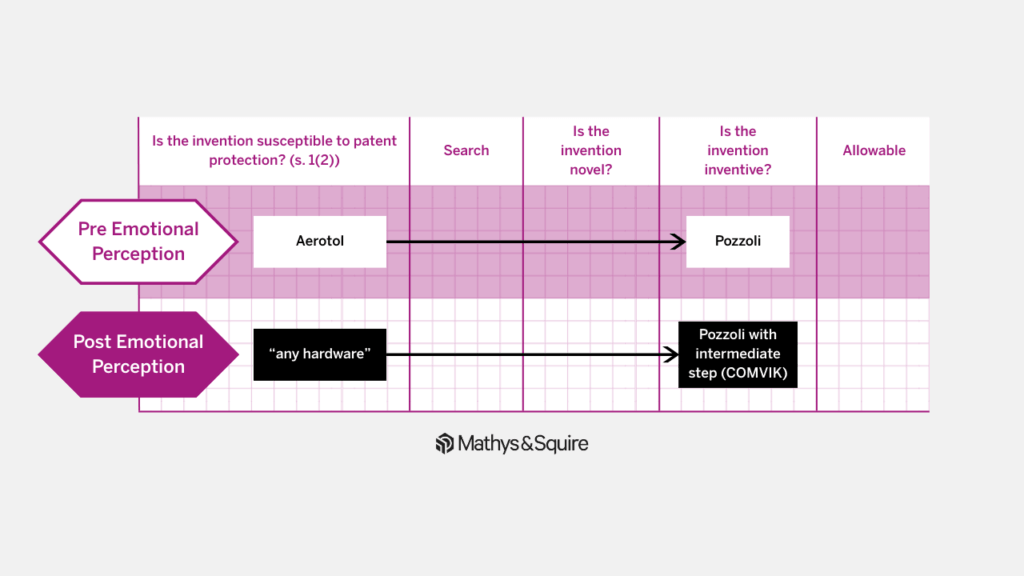
While the ruling provides a lot of much-needed clarity to how subject matter eligibility should be assessed, it will still take some time for us to understand how the ruling will affect the UKIPO’s examination practice. Nonetheless, the ruling also aligns UK practice far more closely with the approach of the EPO by splitting the assessment of subject matter eligibility into two hurdles. The first hurdle is far lower than that established in Aerotel and the more substantive second hurdle is now considered as a part of the assessment of inventive step.
This may not seem like a significant change, since a patent still needs to not fall into one of the exclusions, and the assessment is simply moved to later in the process. Nonetheless, this small change should have a big increase in certainty for businesses and make the decision on where to file first far easier, as crucially, the assessment of inventive step is after an application has been searched.
First filings
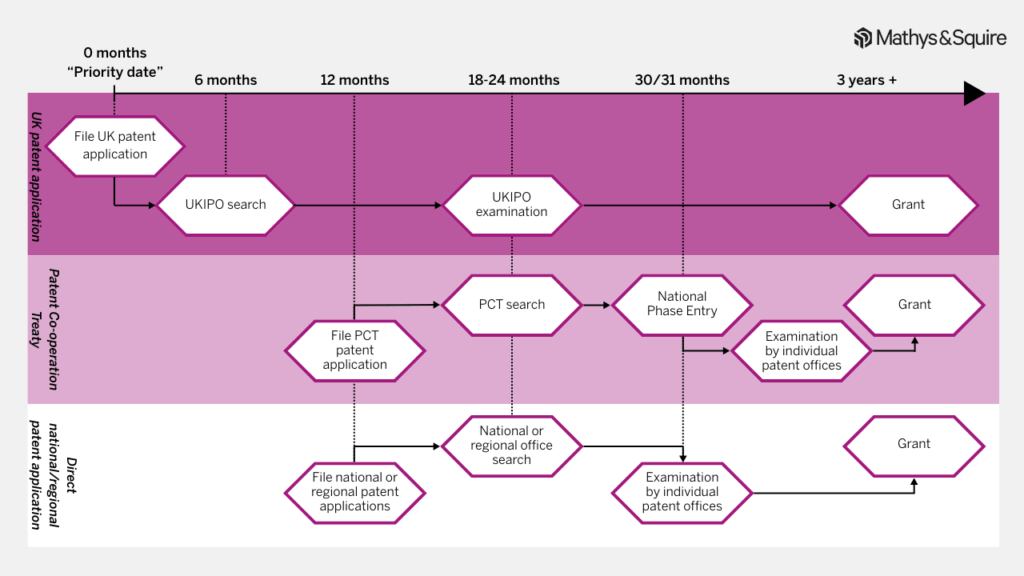
Filing a patent application can be expensive, even more so when managing an international portfolio of applications, but there are strategies to help spread these costs over time.
Typically, it is best not to file patent applications in all the jurisdictions of interest at once and instead file in a single location first (i.e. your first filing). It is also a good idea to make use of the Paris Convention priority period to give yourself a further 12 months before you need to think about international jurisdictions or PCT applications. 12 months can be a significant period of time for start-ups and SMEs to secure funding, validate products and develop their commercial offering. Furthermore, having an initial filing from which to claim priority allows companies to discuss their product with third parties without risk of invalidating their own IP.
From a strategy perspective, a single first filing also means that applicants can get an initial indication of an application’s prospects for a relatively small investment compared to international filings.
Filing at the UKIPO is great value in this regard. With official fees of £310 for 25 claims (increasing to £405 in April 2026), an applicant can get a high-quality search typically within 6 months, giving plenty of time to review, assess and plan an international strategy, without breaking the bank. Compare this to the EPO, which charges EUR 1645 for only 15 claims (increasing to EUR 1730 in April 2026).
But if the UKIPO already offered this service, how does the new ruling impact this strategy?
AI, computer-implemented and mixed-type inventions
Provided that the application meets subject matter eligibility requirements, the above provides businesses with a cost-effective way of getting an early steer on strategy before considering international filings. However, when the Aerotel test was the standard, the experience of applicants whose inventions related to certain subject matter, particularly those related to AI, computer-implemented inventions or inventions related to one or more of the exclusions in the Patents Act recited below (so-called ‘mixed type’ inventions) was often very different.
Exclusions from patentability
To summarise, the Patents Act 1977 excludes inventions from patentability only to the extent that it relates to the following as such:
- a discovery, scientific theory or mathematical method;
- a literary, dramatic, musical or artistic work or any other aesthetic creation whatsoever;
- a scheme, rule of method for performing a mental act, playing a game or doing business, or a program for a computer;
- the presentation of information.
Effectively, if your invention relates solely (i.e. “as such”) to one or more of the areas listed above, then you cannot protect it with a patent. The question then is, what do we mean by “invention”? The entire product as a whole? Or the specific innovation that has never been done before?
The Aerotel test
Under Aerotel, it was established that “invention” was taken to refer to the innovation itself (the “technical contribution”). The Aerotel test established that the following steps must be considered to determine whether a claim was excluded:
- Properly construe the claim.
- Identify the actual contribution (although at the application stage this might have to be the alleged contribution).
- Ask whether the contribution falls solely within the excluded matter (e.g., is it only a computer program, business method, or mathematical method?).
- Check whether the actual or alleged contribution is actually technical.
A challenge with the Aerotel test was that it was applied before any search had been performed, and so the assessment of the “actual contribution” was a nebulous one, since it was done without reference to any prior art. As a result, the UKIPO would sometimes raise objections at the patent eligibility stage, before a search had been performed, leaving applicants without any indication as to what already exists.
This would leave applicants with a difficult choice.
- Run the risk of paying £310 and not getting a search. This would leave applicants to argue a case without ever getting sight of prior art and reaching the 12-month priority deadline none the wiser regarding prospects in other jurisdictions; or
- Pay nearly 5x the fees to file first at the EPO instead.
While UK patent law and EPO practice is supposed to be aligned, the way the law is applied in these different jurisdictions, for example through application of the Aerotel test, would often mean that UK practice diverged from that at the EPO.
The EPO’s ‘any hardware’ test
The hope is that now both jurisdictions should be more closely aligned. In particular, as a result of the Supreme Court judgment, the UKIPO now also uses the ‘any hardware’ test that is used by the EPO for determining whether subject matter is excluded. Put simply, if your claimed invention has any implied technical means (e.g. a computer-implemented method inherently requires a computer to run), then the invention is not excluded. While a program for a computer is a listed exclusion, it is very difficult for a program for a computer to fail the ‘any hardware’ test, since it is implied that a computer is necessary for it to operate.
This first hurdle is inherently a very low one. Indeed, given that nearly all AI-related inventions are implemented on a computer, passing subject matter exclusions is a relatively trivial step at the EPO, and now at the UKIPO too.
This means that it is now easier for inventions to pass the barrier from which the patent office will conduct a search, i.e. if there is at least one technical feature (“any hardware”), there is something that can (and should) be searched.
Does this mean it is easier to get an AI-related patent at the UKIPO?
Ultimately, it is still too early to tell how the UKIPO may update their guidance for how inventive step should be updated in light of this judgment.
However, what is certain is that, rather than talking about subject matter eligibility before considering anything else, much of the focus of subject matter exclusions moves to inventive step. A fundamental requirement for assessing inventive step is an awareness of the prior art, and so, an examiner must have done a search to be able to reject an application on the grounds of inventive step.
Therefore, the biggest takeaway of this latest decision for businesses is that AI, computer-implemented and mixed-type inventions now rejoin the rest of the tech domain, and the UKIPO becomes an even better location for applicants to consider their first filings.
Businesses will no longer need to trade off budgets with strategic certainty before PCT. Now, start-ups and SMEs can defer their costs much more reliably, safe in the knowledge that the UKIPO’s cheap official fees will return a high-quality search, regardless of subject matter.
At Mathys & Squire LLP, we have extensive experience of patent drafting for AI and computer-implemented inventions, as well as a deep understanding of the needs of startups. For more information, please reach out to a member of our Scaleup Quarter team.